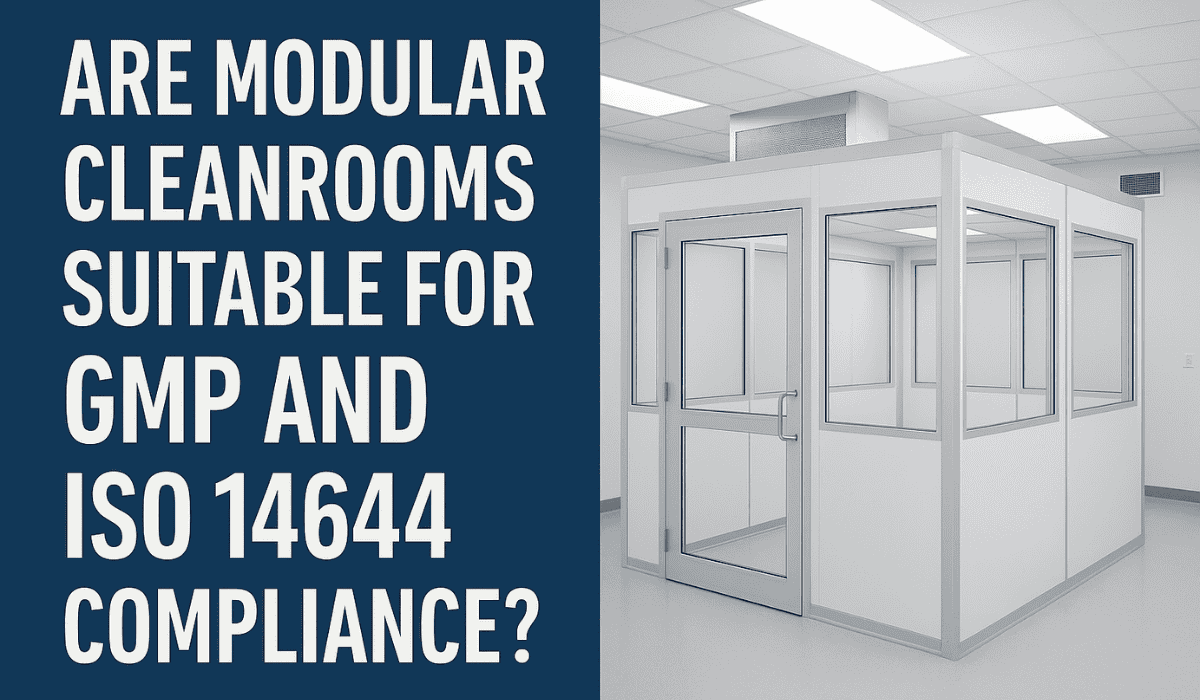
Modular cleanrooms can support ISO 14644 classification and Good Manufacturing Practice requirements when they are properly designed, installed, tested, and operated for their intended application.
Their suitability does not come from the modular construction method alone. It depends on how effectively the complete facility controls airborne particles, personnel and material movement, pressure relationships, temperature, humidity, microbial risks, and other process-specific conditions.
A modular cleanroom must therefore be evaluated in the same way as a traditionally constructed cleanroom.
Its enclosure, filtration, HVAC, utilities, monitoring systems, operating procedures, and qualification documentation must work together to support the applicable cleanliness and manufacturing requirements.
What Is a Modular Cleanroom?
A modular cleanroom is assembled from pre-engineered wall, ceiling, door, glazing, and structural components. These components are manufactured before delivery and installed within or alongside an existing facility.
Common modular cleanroom systems include:
- Hardwall cleanrooms with rigid wall panels
- Softwall cleanrooms with flexible curtain enclosures
- Freestanding rooms constructed inside existing buildings
- Multi-room suites with gowning and material-transfer areas
- Modular rooms connected to dedicated or existing HVAC systems
Unlike conventional construction, a modular system can often be expanded, reconfigured, or partially relocated when operational requirements change. However, the ease of modification depends on the room’s HVAC, utilities, equipment, process validation, and regulatory requirements.
Modular construction describes how the enclosure is built. It does not independently determine the room’s ISO classification or GMP suitability.
How Does ISO 14644 Apply to Modular Cleanrooms?
ISO 14644-1 classifies cleanrooms according to the concentration of airborne particles measured at specified particle sizes. It applies to cleanrooms based on performance rather than whether their walls were built using modular panels or conventional construction.
ISO describes ISO 14644-1 as a system for classifying air cleanliness by particle concentration.
A modular cleanroom may be designed for a target classification such as ISO Class 5, ISO Class 7, or ISO Class 8. Whether it achieves that class depends on factors including:
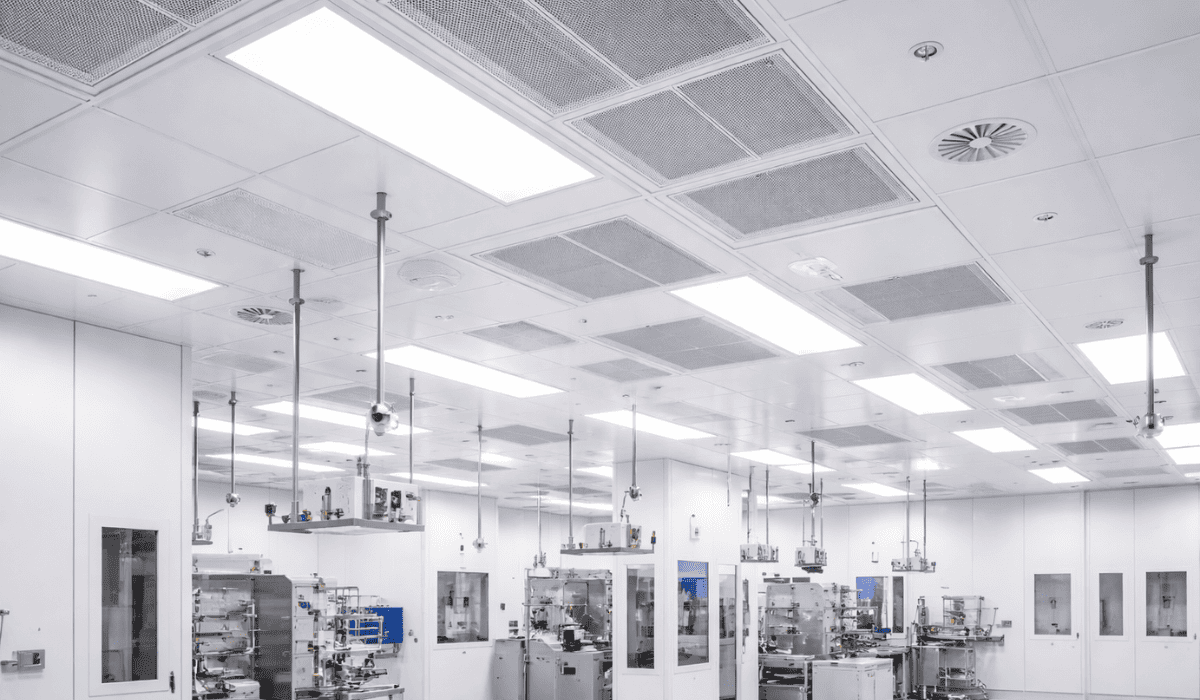
- HEPA or ULPA filter coverage
- Airflow volume and distribution
- Supply and return locations
- Room size and layout
- Envelope sealing
- Door-opening frequency
- Personnel and equipment loads
- Process-generated particles
- Gowning and cleaning procedures
- Conditions in adjacent spaces
- The occupancy state used for classification
ISO 14644-1 does not assign a fixed number of air changes per hour to every ISO class. Airflow requirements must be developed according to the process, room configuration, contamination load, recovery expectations, and specified operating conditions.
The completed modular cleanroom must undergo particle-count testing before its classification can be confirmed. Depending on the project, additional testing may include filter integrity, airflow, room pressure, temperature, humidity, recovery performance, and airflow visualization.
How Does GMP Apply to a Modular Cleanroom?
GMP addresses much more than airborne particle classification. It concerns the systems used to ensure that products are consistently manufactured and controlled according to applicable quality requirements.
FDA current Good Manufacturing Practice regulations establish requirements for the methods, facilities, and controls used in manufacturing, processing, and packing drug products. These requirements are intended to support product identity, strength, quality, and purity.
For a modular cleanroom used in a regulated pharmaceutical environment, relevant considerations may include:
- Suitable room finishes and cleanability
- Prevention of contamination and cross-contamination
- Personnel and material flows
- Gowning and transfer procedures
- Air pressure relationships
- Temperature and humidity control
- Equipment arrangement and cleaning access
- Process and utility integration
- Environmental monitoring
- Cleaning and disinfection procedures
- Maintenance and calibration
- Qualification and validation
- Documentation and change control
The requirements depend on the product, process, jurisdiction, and applicable regulatory framework. A room used for nonsterile packaging will not necessarily require the same controls as an aseptic processing area.
Modular construction can support these requirements, but the manufacturer remains responsible for establishing that the facility and process are suitable for their intended use.
Why Modular Cleanrooms Excel in Compliance
Many organizations now choose modular systems specifically because they make GMP and ISO compliance easier to achieve — not harder.
Here’s why modular cleanrooms are so effective:
Consistent, Factory-Built Quality
Modular components are manufactured in controlled environments, ensuring precision tolerances, clean finishes, and consistent quality.
Every panel, door, and ceiling tile is pre-tested and verified for air-tightness and particle control before installation.
That level of repeatable quality control is hard to match in field construction.
Faster Installation Without Cutting Corners
Traditional builds can take months or even a year to complete. Modular systems cut that timeline dramatically — often by 40-50% — without skipping compliance steps.
Since every component is pre-engineered, installation happens cleanly and efficiently on-site, reducing dust, waste, and cross-contamination risk.
Designed for Validation and Re-Certification
Each modular cleanroom can be validated exactly the same way as a traditional cleanroom — through particle counts, airflow tests, pressure mapping, and filter integrity testing.
Because modular systems have precise seals and pre-tested joints, they often deliver more predictable results during ISO and GMP validation.
Seamless Surfaces for Easy Cleaning
GMP guidelines require surfaces that resist particle buildup and are easy to disinfect. Modular panels are built from non-porous, anti-static materials — such as powder-coated aluminum or PVC-laminated steel — that meet those requirements perfectly.
Simplified Maintenance and Upgrades
Over time, process needs change. Modular cleanrooms make compliance easier because they can be expanded, modified, or repaired without re-building from scratch.
Need to add a new ISO 6 room next year? Simply extend the modular system with matching components — no need for disruptive demolition.
Real-World Applications — Where Modular Cleanrooms Shine
Modular cleanrooms aren’t theoretical. They’re used by leading companies in every high-tech and regulated industry.
Here are a few examples where modular systems meet full GMP and ISO compliance:
- Pharmaceutical manufacturing: Modular ISO 7 and 8 suites for packaging, weighing, and compounding.
- Biotech research: Modular softwall and hardwall spaces for genetic testing and tissue culture.
- Medical device assembly: ISO 7 cleanrooms with integrated pass-throughs and gowning rooms.
- Semiconductor fabrication: Modular ISO 5 microelectronics rooms with laminar airflow.
- EV battery and energy storage: Dry room modular systems with humidity control below 1%.
Each of these facilities requires strict adherence to GMP and ISO standards — and modular design delivers both flexibility and compliance.
The Role of a Certified Cleanroom Contractor
The key to a compliant modular cleanroom isn’t just the system — it’s the team that designs and installs it.
A certified cleanroom contractor, like Ultrapure Technology, ensures that every modular system meets ISO and GMP from the ground up.
That includes:
- Selecting panel systems that meet cleanroom classifications.
- Engineering airflow and pressure zones correctly.
- Integrating HEPA/ULPA filtration and HVAC systems.
- Conducting final validation and third-party certification.
When you partner with a qualified cleanroom design and build company, your modular system becomes a fully certified, production-ready environment.
Common Myths About Modular Cleanrooms
Despite their proven track record, modular cleanrooms are still misunderstood. Let’s clear up a few common myths:
Myth 1: Modular cleanrooms aren’t as durable as traditional ones.
Fact: Modular cleanrooms use structural aluminum, steel, and composite panels — designed for 20+ years of continuous operation. Many are even seismic and fire-rated.
Myth 2: They can’t meet ISO 5 or higher standards.
Fact: Modular systems are capable of meeting ISO Class 4 and 5 — as long as HVAC and filtration systems are designed accordingly.
Myth 3: They’re only for temporary use.
Fact: Many modular cleanrooms are permanent installations, simply easier to modify or relocate when needed.
H2: Modular vs. Traditional Cleanroom Compliance — A Quick Comparison
| Feature | Modular Cleanroom | Traditional Cleanroom |
| Construction Time | 40–50% faster | Slower (months longer) |
| ISO/GMP Compliance | Fully compliant | Fully compliant |
| Flexibility | Easy to expand or relocate | Fixed and permanent |
| Cost Efficiency | Lower overall cost | Higher material/labor costs |
| Maintenance | Easier to clean and modify | Requires more downtime |
| Documentation | Pre-validated components | Site-validated manually |
As you can see, modular systems don’t just match compliance — they often improve the validation process.
How Ultrapure Technology Delivers Modular GMP and ISO-Compliant Cleanrooms
At Ultrapure Technology, we’ve helped hundreds of organizations move to modular cleanroom systems without sacrificing performance.
Our turnkey modular cleanroom solutions include:
- Custom design and engineering for your ISO class or GMP grade.
- Modular wall, ceiling, and flooring systems with cleanroom-rated finishes.
- Integrated HVAC and filtration for airflow control.
- Third-party testing, validation, and certification.
- Ongoing maintenance and re-certification support.
We don’t just build modular rooms — we build compliant, production-ready environments designed for long-term success.
Custom ISO Cleanrooms: Tailored for Every Industry
Every manufacturing or research environment has unique requirements, and off-the-shelf solutions rarely meet strict compliance standards.
Custom ISO cleanrooms are designed to fit your exact needs, whether it’s a pharmaceutical production line, a biotech research lab, or a medical device assembly area.
Certified contractors handle the full cleanroom design and construction process, ensuring that every panel, airflow system, and filtration unit aligns with ISO 14644 standards and GMP requirements. This level of customization guarantees both operational efficiency and regulatory compliance.
Streamlined Cleanroom Customization and Installation
Partnering with experienced cleanroom installation contractors ensures that your facility not only meets design specifications but is installed correctly from the start.
Cleanroom customization goes beyond aesthetics , it involves configuring modular walls, pressure zones, and HVAC systems so that particle control, airflow, and environmental monitoring operate seamlessly.
Proper installation minimizes downtime, reduces revalidation costs, and provides a turnkey solution that supports both current production needs and future expansions.
Final Thoughts
So, are modular cleanrooms suitable for GMP and ISO 14644 compliance?
Without question — yes.
When designed and installed by an experienced cleanroom contractor, modular systems provide the same (or better) air cleanliness, documentation, and safety standards as traditional builds.
They’re faster to construct, easier to modify, and fully capable of passing GMP and ISO audits in even the most regulated industries.
At Ultrapure Technology, we specialize in turnkey modular cleanroom solutions that deliver compliance, performance, and flexibility — all in one system.
If you’re planning to expand production, open a new facility, or modernize your cleanroom, let’s design a modular system that’s ready for certification from day one.
Contact Ultrapure Technology today to schedule your consultation.
Frequently Asked Questions (FAQs)
Can Modular Cleanrooms Meet GMP and ISO 14644 Standards?
Modular cleanrooms can support GMP requirements and achieve an ISO 14644 classification when their enclosure, filtration, airflow, utilities, finishes, and operating controls are designed for the intended process. ISO classification must be confirmed through airborne particle-count testing. GMP suitability requires broader qualification, documentation, procedures, monitoring, and quality controls beyond the cleanroom structure itself.
What Makes a Modular Cleanroom Suitable for GMP Operations?
GMP suitability depends on the complete manufacturing environment rather than the modular panels alone. The cleanroom should incorporate cleanable surfaces, appropriate pressure relationships, controlled personnel and material flows, properly integrated equipment, and environmental controls suited to the process. The facility must also support cleaning, maintenance, monitoring, qualification, documentation, and change-control procedures.
Are Modular Cleanrooms Durable Enough for Long-Term Use?
Modular cleanrooms can provide long-term service when their structural components, panels, finishes, seals, doors, and ceiling systems are selected for the operating environment. Durability depends on material quality, chemical exposure, cleaning frequency, equipment activity, maintenance, and installation quality. Damaged panels or seals can often be repaired or replaced without reconstructing the entire room.
Can Modular Cleanrooms Achieve ISO Class 5 or ISO Class 6?
A modular cleanroom may achieve ISO Class 5 or ISO Class 6 when its HVAC capacity, HEPA or ULPA filtration, airflow pattern, envelope sealing, room layout, and operating procedures support the applicable particle limits. The modular enclosure does not establish the classification by itself. Performance must be demonstrated through testing under a defined occupancy state.
Why Choose a Modular Cleanroom Over Traditional Construction?
Modular construction may reduce on-site work and make future expansion or reconfiguration more practical. Factory-manufactured components can also provide consistent finishes and controlled dimensions. The best option depends on the required classification, process utilities, facility conditions, project schedule, lifecycle cost, maintenance needs, and anticipated changes—not construction speed or initial cost alone.