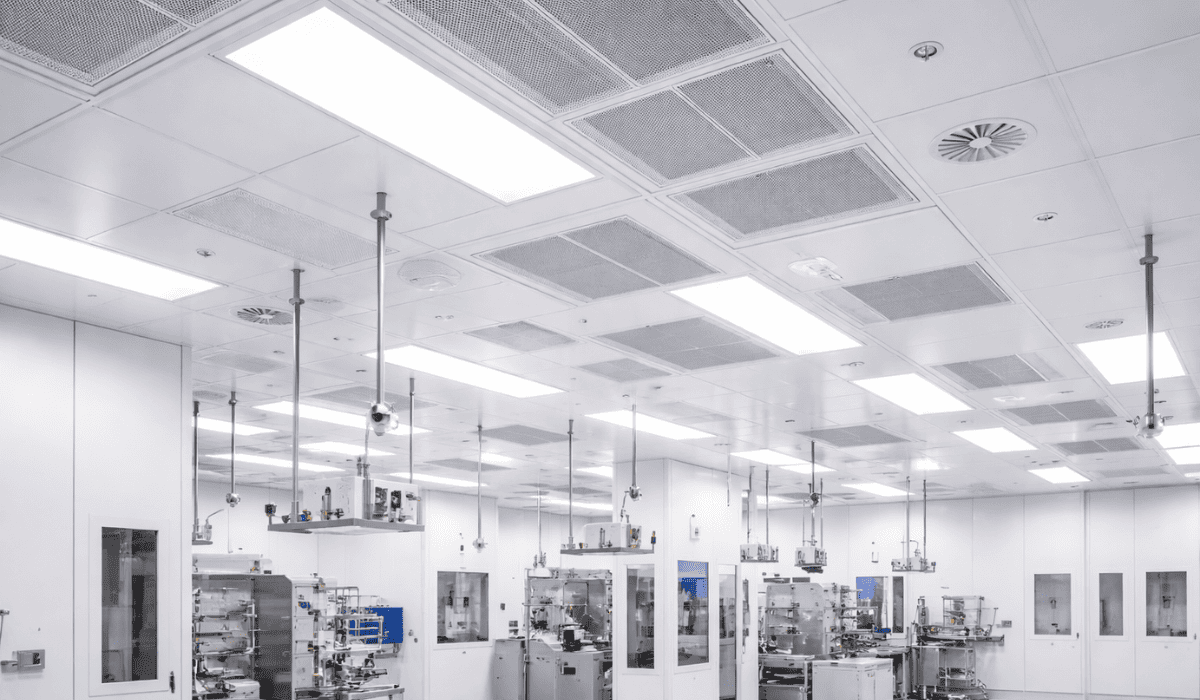
Cleanroom ceiling systems play a critical role in maintaining contamination control, airflow stability, and regulatory compliance across controlled environments.
While floors and walls often receive attention during cleanroom construction, ceiling systems directly influence air distribution, filtration efficiency, pressure balance, and long-term cleanroom performance.
From pharmaceutical manufacturing and semiconductor fabrication to biotechnology and aerospace facilities, ceiling systems in cleanrooms must support strict ISO and GMP standards while integrating seamlessly with HVAC, lighting, and utility infrastructure.
A well-designed ceiling system is not simply a structural element, it is an essential part of contamination control strategy and operational reliability.
What Are Cleanroom Ceiling Systems?
Cleanroom ceiling systems are engineered ceiling assemblies designed specifically for controlled environments where particulate, microbial, and environmental conditions must be tightly regulated.
Unlike conventional ceilings, these systems form an airtight boundary that supports airflow control, filtration, lighting, and service access without compromising cleanliness.
Cleanroom ceiling design focuses on precision sealing, material compatibility, and integration with mechanical systems.
Ceiling systems must align with cleanroom walls and floors to maintain pressure differentials and prevent contamination migration between spaces.
Core Functions of Ceiling Systems in Cleanrooms
Cleanroom ceiling systems are designed to support multiple critical functions simultaneously:
- Secure installation of HEPA or ULPA filtration systems
- Maintenance of uniform airflow patterns and laminar flow
- Housing of cleanroom lighting, sprinklers, and utilities
- Creation of sealed plenum spaces for air return management
- Providing safe access for maintenance without contamination risk
Each function directly impacts cleanroom classification stability and long-term compliance.
Why Cleanroom Ceiling Systems Are Critical to Performance
Ceiling systems in cleanrooms influence how effectively air moves, contaminants are controlled, and environmental parameters remain stable.
Poor ceiling design can lead to turbulence, particle accumulation, and inconsistent pressure zones.
A properly engineered cleanroom ceiling supports predictable airflow paths, minimizes particle shedding, and ensures that filtration systems operate at peak efficiency.
These factors are essential for facilities seeking consistent ISO cleanroom compliance over time.
Ceiling Systems and Contamination Control
Contamination control ceiling systems are designed to eliminate potential contamination sources from above the cleanroom envelope.
Smooth, non-porous surfaces reduce particle adhesion and microbial growth, while sealed joints prevent infiltration from interstitial spaces.
Flush transitions between ceiling panels and fixtures further reduce turbulence and particle traps.
This design approach is especially critical in high-precision aerospace, pharmaceutical, and semiconductor manufacturing environments.
Types of Cleanroom Ceiling Systems
Different cleanroom applications require different ceiling configurations.
Selection depends on ISO classification, operational requirements, and maintenance strategy.
Flush Cleanroom Ceiling Systems
Flush cleanroom ceiling systems feature smooth, level surfaces where lighting, filters, and utilities sit flush with ceiling panels.
This design minimizes particle accumulation and airflow disruption.
These systems are commonly used in ISO Class 5–7 environments where stringent contamination control is required, such as pharmaceutical cleanroom ceiling applications and biotechnology labs.
Walkable Cleanroom Ceilings
Walkable cleanroom ceilings are structurally reinforced to allow maintenance personnel to access plenum areas above the cleanroom without entering the controlled space.
This design improves operational efficiency and reduces downtime.
Walkable cleanroom ceilings are frequently used in semiconductor manufacturing and advanced electronics facilities where frequent service access is required without disrupting production.
Modular Cleanroom Ceiling Systems
Modular cleanroom ceiling systems use prefabricated grid structures that allow for flexibility and future expansion.
Panels, filters, and utilities can be reconfigured as processes change.
These systems support faster installation timelines and are ideal for facilities anticipating growth or evolving production needs.
Cleanroom Ceiling Materials and Surface Finishes
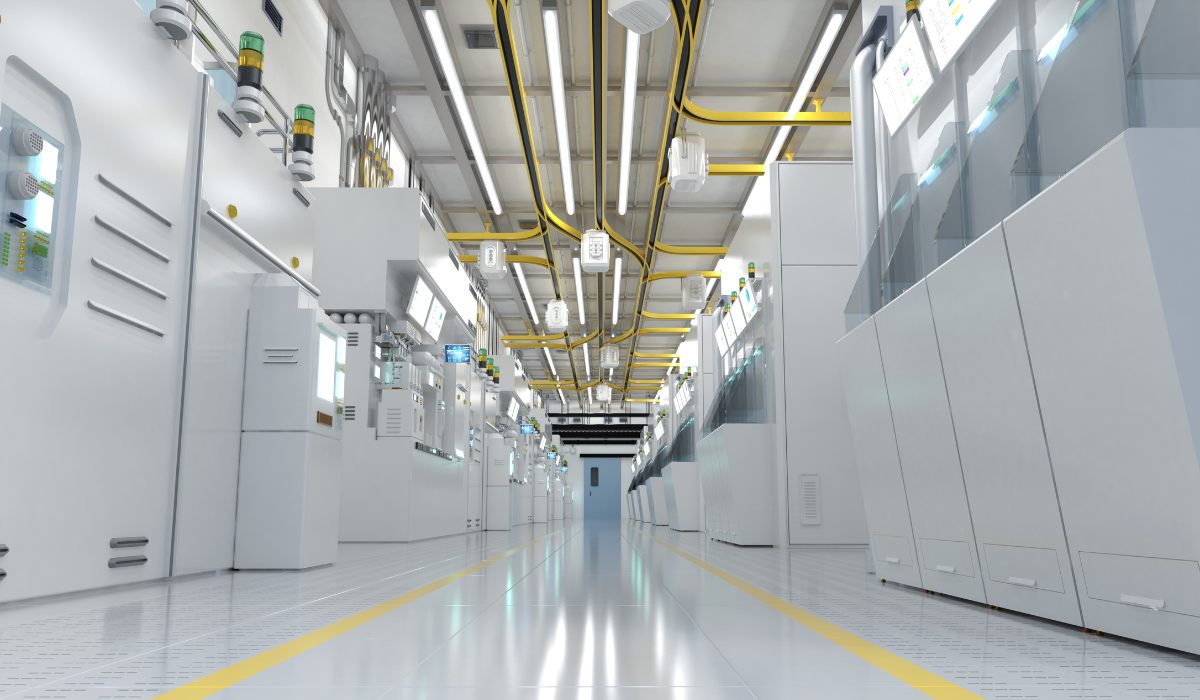
Material selection is a critical factor in cleanroom ceiling construction.
Ceiling materials must resist corrosion, withstand aggressive cleaning agents, and maintain structural integrity over time.
Common Cleanroom Ceiling Materials
Cleanroom ceiling materials are selected based on durability, cleanability, and compatibility with regulatory standards:
- Powder-coated steel for durability and corrosion resistance
- Aluminum panels for lightweight, non-shedding performance
- Vinyl-faced gypsum for cost-effective controlled environments
- Composite panels designed for high-humidity or sterile spaces
Surface Finish Requirements
Cleanroom ceiling surfaces must be smooth, non-porous, and easy to disinfect.
Textured finishes are avoided due to their tendency to trap particles and microorganisms.
Seamless finishes support consistent cleaning protocols and contamination control.
ISO and GMP Cleanroom Ceiling Requirements
ISO cleanroom ceiling requirements focus on maintaining classification integrity through proper airflow, sealing, and material performance.
Ceiling systems must support consistent particle control during both operation and maintenance.
GMP cleanroom ceiling standards emphasize cleanability, chemical resistance, and documentation readiness.
Ceilings must withstand frequent sanitation while maintaining their integrity over extended operational lifecycles.
Ceiling system validation is often part of overall cleanroom qualification and should be considered early in design planning.
Cleanroom Ceiling Applications by Industry
Cleanroom Ceiling for Pharmaceutical Facilities
Pharmaceutical cleanroom ceiling systems support sterile production, controlled airflow, and regulatory inspections.
Flush ceiling designs, integrated HEPA filtration, and chemical-resistant materials are essential for maintaining GMP compliance.
Cleanroom Ceiling for Semiconductor Manufacturing
Semiconductor cleanroom ceiling design prioritizes ultra-low particle counts, precise airflow control, and service accessibility.
Walkable ceilings and advanced plenum designs are commonly used to support continuous operations.
Cleanroom Ceiling for Biotechnology and Research Labs
Biotech facilities rely on ceiling systems that balance contamination control with flexibility.
Modular cleanroom ceiling systems allow for reconfiguration as research needs evolve.
Integrating HVAC Systems Within Cleanroom Ceiling Design
Cleanroom HVAC ceiling integration is a core component of ceiling system design because it directly influences airflow performance, contamination control, and environmental stability.
Ceiling systems serve as the primary interface between the cleanroom envelope and mechanical systems, supporting the precise delivery and return of conditioned air.
Key HVAC integration objectives include:
- Maintaining consistent airflow velocity across the cleanroom ceiling plane
- Supporting uniform air distribution to reduce particle accumulation
- Preserving pressure differentials between cleanroom zones
- Ensuring stable environmental conditions during operation
Ceiling panels are engineered to securely accommodate air supply diffusers, return grilles, HEPA or ULPA filters, lighting fixtures, and fire protection systems.
These elements must be positioned flush with ceiling surfaces to reduce airflow disruption and eliminate particle collection points.
Ceiling-mounted components commonly integrated include:
- HEPA and ULPA filtration units
- Laminar airflow diffusers and perforated panels
- Return air grilles and exhaust pathways
- Recessed cleanroom lighting systems
- Fire suppression and monitoring devices
Proper coordination between ceiling systems and HVAC design prevents dead zones where particles can settle and ensures that pressure differentials between adjacent cleanroom spaces remain stable.
This coordination is especially critical in facilities with multiple cleanroom classifications, where pressure cascades must be maintained to prevent cross-contamination.
Design coordination considerations include:
- Diffuser placement aligned with process equipment layout
- Balanced air supply and return positioning
- Sealed ceiling penetrations to prevent leakage
- Integration with cleanroom zoning and pressure strategies
Cleanroom ceiling plenum design plays a vital role in HVAC performance by managing return air paths above the cleanroom.
A well-designed plenum allows air to move efficiently back to the HVAC system without creating pressure imbalances or drawing contaminants into the controlled environment.
Plenum design supports:
- Efficient return airflow routing
- Isolation of ductwork and utilities from cleanroom space
- Reduced turbulence above the ceiling plane
- Long-term system performance and accessibility
In high-precision environments such as pharmaceutical manufacturing, semiconductor fabrication, and biotechnology labs, HVAC ceiling integration must also support validation and ongoing compliance.
Ceiling systems should allow access for inspection and maintenance without disturbing cleanroom conditions.
Maintenance-friendly ceiling features often include:
- Walkable ceiling systems for overhead access
- Modular panels for localized servicing
- Sealed access points to maintain cleanroom integrity
- Compatibility with validation and inspection protocols
Ultimately, effective cleanroom HVAC ceiling integration is not achieved through isolated design decisions.
It requires early collaboration between cleanroom designers, HVAC engineers, and construction teams to ensure that airflow performance, contamination control, and long-term maintainability are built into the ceiling system from the start.
Installation and Cleanroom Ceiling Construction Considerations
Cleanroom ceiling construction requires precision installation to ensure airtight seals and proper alignment.
Even minor gaps or misalignments can compromise cleanroom performance.
Installation planning should consider future maintenance access, equipment upgrades, and validation requirements.
Modular systems often reduce construction timelines while maintaining performance standards.
Long-Term Performance and Maintenance
Ceiling systems must maintain performance under continuous operation, frequent cleaning, and routine maintenance.
Selecting durable materials and accessible designs reduces long-term operational costs.
Regular inspections of seals, panels, and fixtures help maintain ISO cleanroom compliance and prevent contamination issues before they escalate.
Conclusion
Cleanroom ceiling systems are foundational to contamination control, airflow management, and regulatory compliance.
From material selection and system type to HVAC integration and industry-specific applications, ceiling systems influence every aspect of cleanroom performance.
By prioritizing proper cleanroom ceiling design during planning and construction, facilities achieve greater operational reliability, easier maintenance, and long-term compliance across controlled environments.
Get Professional Cleanroom Design and Construction Services for Ceiling Systems
At UltraPure Technology, we specialize in designing and constructing high-performance cleanroom ceiling systems that align with ISO standards, GMP requirements, and industry-specific operational needs.
Our team delivers integrated cleanroom solutions that support contamination control, HVAC coordination, and future scalability.
If you are planning a new cleanroom or upgrading an existing controlled environment, our experts can help ensure your ceiling systems support long-term performance and compliance.
Contact us today to discuss your cleanroom ceiling system requirements.
Frequently Asked Questions
What is the primary role of cleanroom ceiling systems?
Cleanroom ceiling systems form a sealed upper boundary that supports airflow control, filtration placement, and contamination prevention. They integrate lighting, HVAC components, and utilities while maintaining consistent environmental conditions. A properly designed ceiling is essential for sustaining cleanroom classification and operational stability.
How do ceiling systems impact contamination control in cleanrooms?
Ceiling systems influence contamination control by minimizing particle shedding and preventing infiltration from overhead spaces. Smooth, non-porous surfaces reduce particle accumulation, while sealed joints eliminate leakage paths. Flush ceiling designs further support predictable airflow and cleaner environments.
What materials are commonly used in cleanroom ceiling construction?
Cleanroom ceiling materials are selected for durability, cleanability, and resistance to chemicals. Common options include powder-coated steel, aluminum panels, vinyl-faced gypsum, and composite materials. Each material is chosen based on the cleanroom’s ISO classification and operational demands.
How do cleanroom ceilings support ISO and GMP compliance?
ISO cleanroom ceiling requirements focus on airtight construction, airflow consistency, and surface cleanliness. GMP cleanroom ceiling standards emphasize cleanability, chemical resistance, and long-term durability. Ceiling systems play a direct role in meeting validation and inspection expectations.
What is the difference between flush and walkable cleanroom ceilings?
Flush cleanroom ceiling systems provide smooth, level surfaces that minimize particle traps and airflow disruption. Walkable cleanroom ceilings are structurally reinforced to allow maintenance access from above. The choice depends on maintenance frequency and industry-specific operational needs.
Why are modular cleanroom ceiling systems used in modern facilities?
Modular cleanroom ceiling systems offer flexibility for future expansion and layout changes. Prefabricated components allow faster installation and easier reconfiguration. These systems are ideal for facilities anticipating process upgrades or evolving production requirements.
How does cleanroom HVAC ceiling integration affect performance?
Cleanroom HVAC ceiling integration ensures proper placement of air supply diffusers, returns, and filtration units. Coordinated design prevents turbulence and dead zones while maintaining pressure balance. Effective integration is critical for consistent airflow and contamination control.
What is the purpose of a cleanroom ceiling plenum?
A cleanroom ceiling plenum serves as a controlled space for air return paths and utility routing. Proper plenum design supports efficient airflow management without introducing contamination. It also allows maintenance access while protecting the cleanroom environment below.
When should ceiling systems be planned during cleanroom projects?
Ceiling systems should be planned during the earliest stages of cleanroom design. Early coordination with HVAC, electrical, and process requirements ensures better performance and compliance. Late-stage ceiling changes often lead to costly modifications and validation delays.