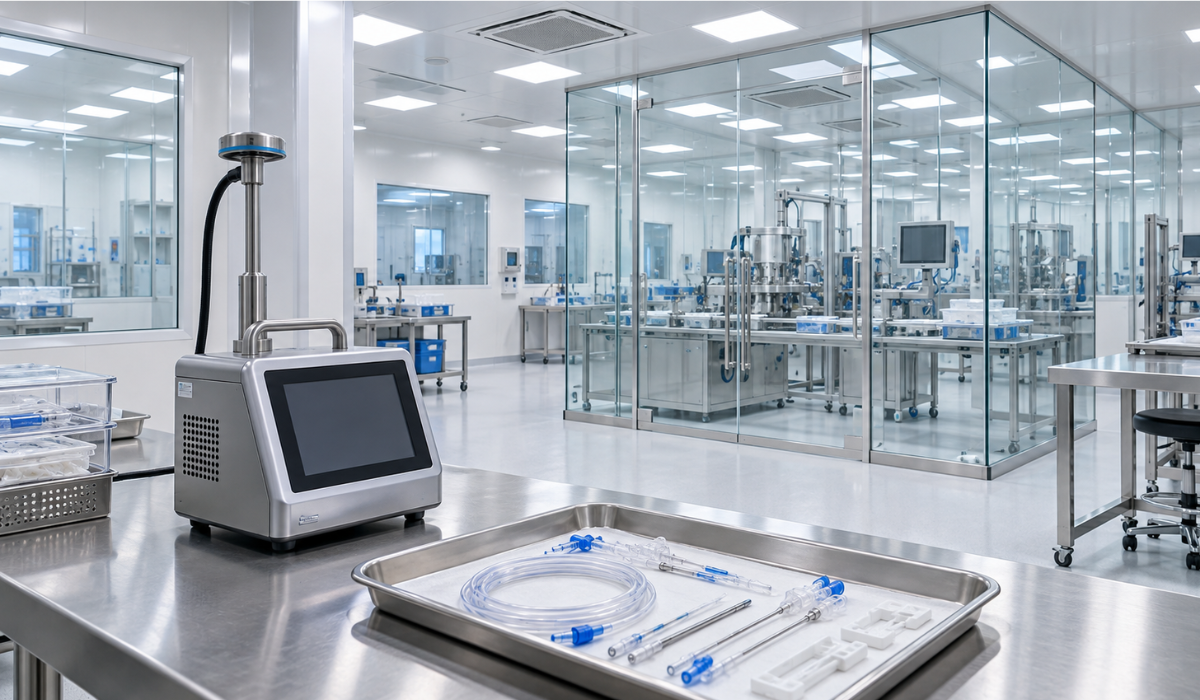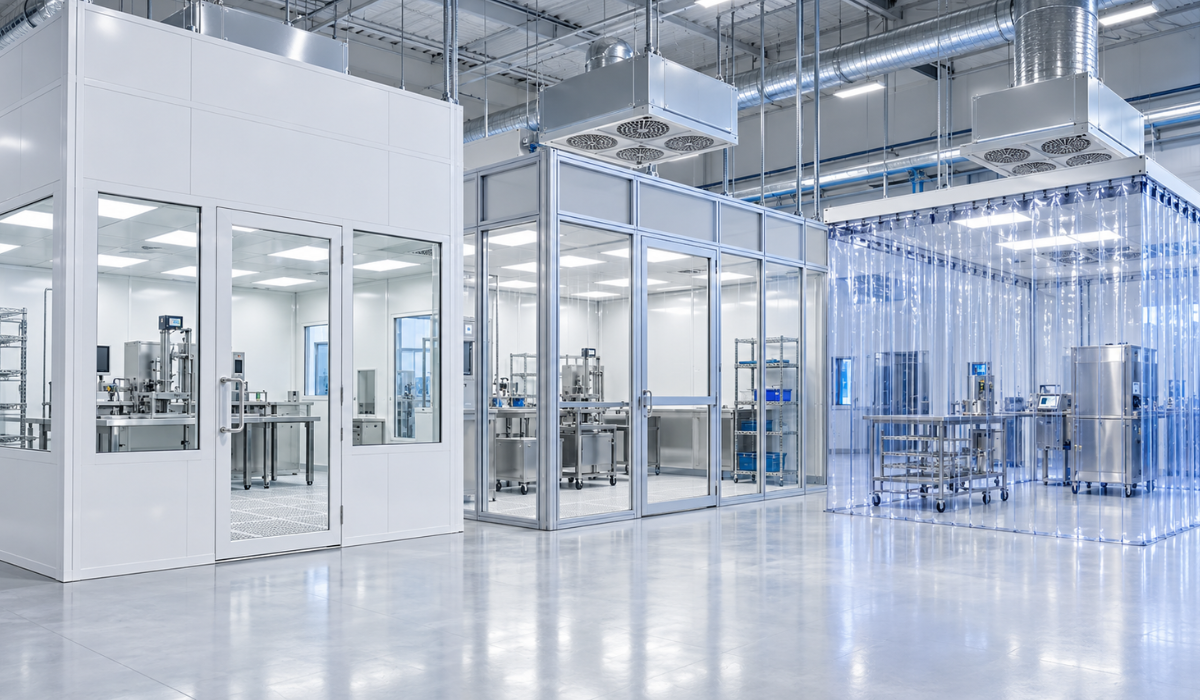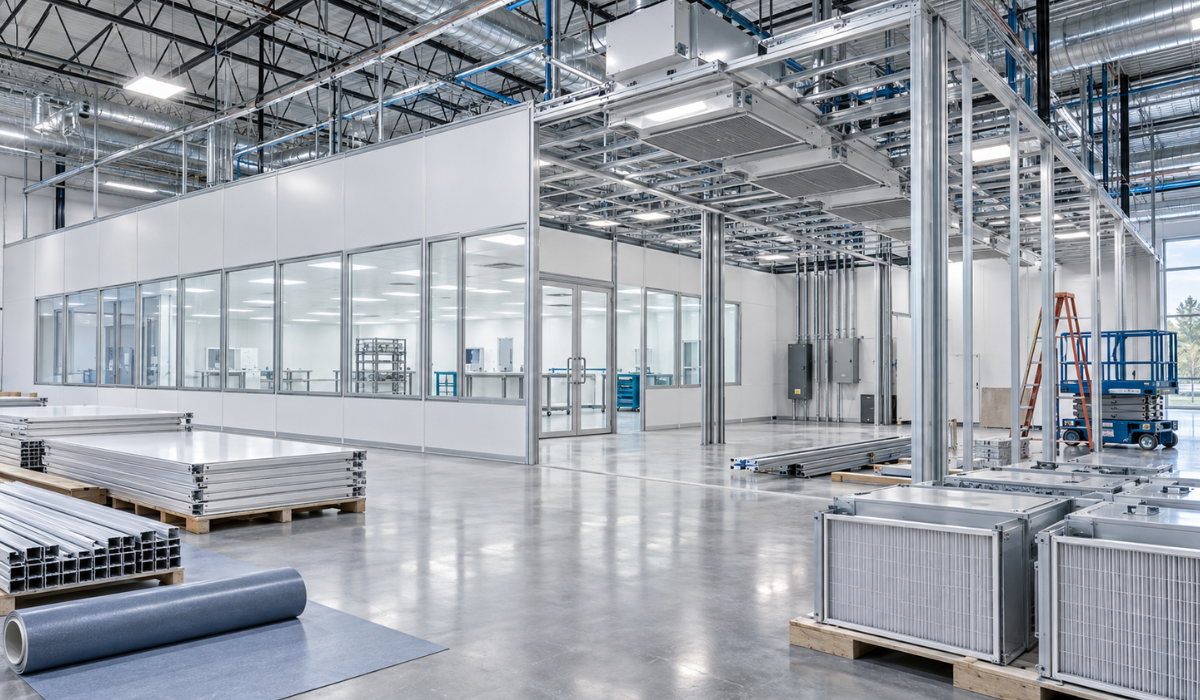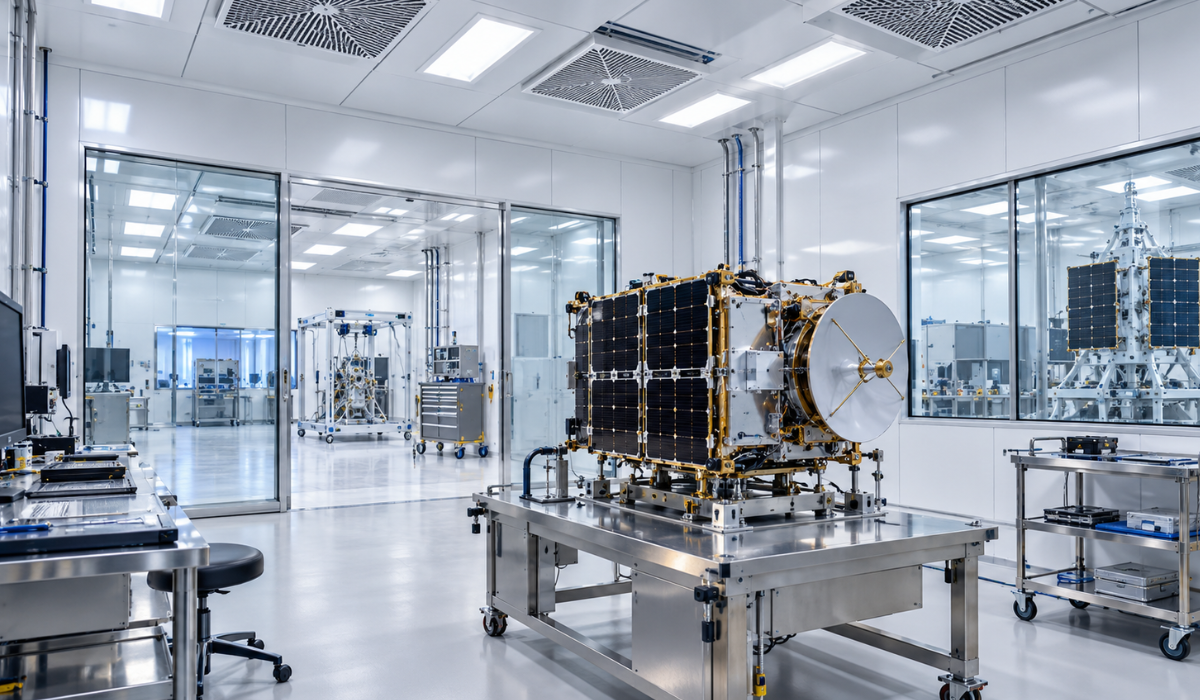
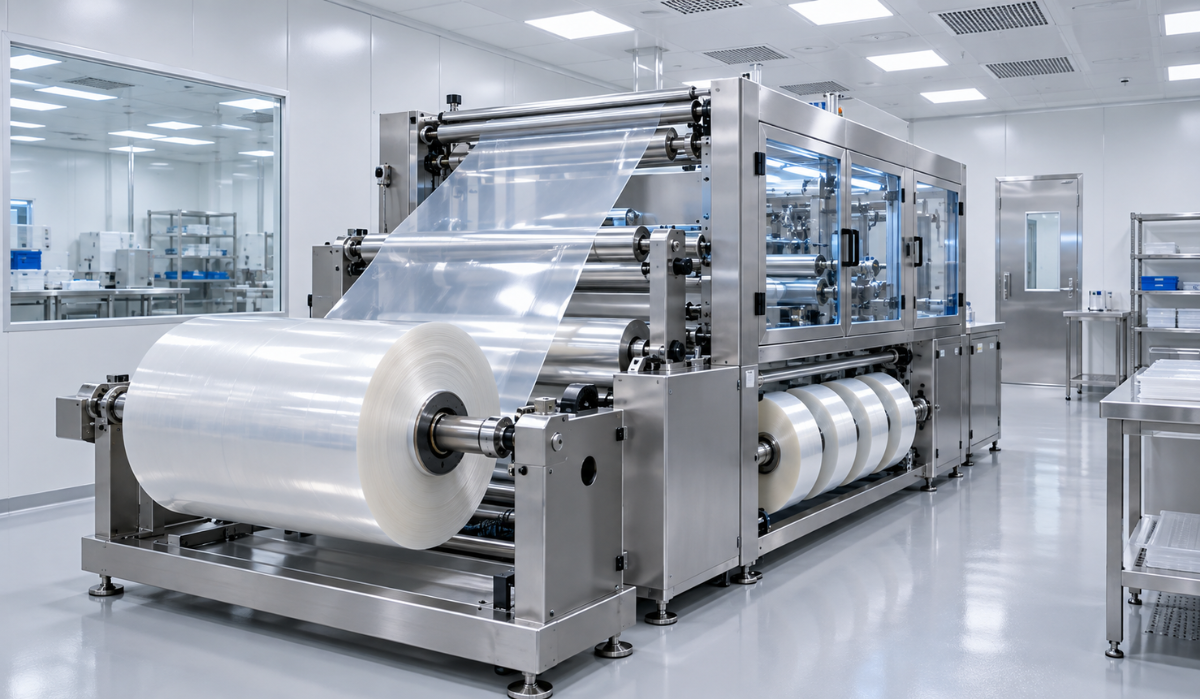
Cleanroom converting may be necessary when airborne particles, fibers, residues, static electricity, temperature changes, or humidity could affect product quality or performance. The need should be determined through a documented risk assessment that considers the material, manufacturing process, customer specifications, and applicable quality requirements.
- ISO 14644-1 classifies cleanroom air according to airborne particle concentration.
- Common converting processes include slitting, laminating, die cutting, rewinding, and precision assembly.
- Frequently processed materials include films, foams, tapes, liners, membranes, labels, and specialty plastics.
- Cleanroom classification controls airborne particles but does not establish product sterility.
- Georgia’s 2026 construction framework incorporates the 2024 International Building Code and International Mechanical Code with state amendments.
A successful converting environment requires more than filtered air. Equipment placement, personnel practices, utility connections, material movement, cleaning procedures, and environmental controls must work together to manage the identified risks.
For manufacturers in Suwanee and the surrounding Atlanta industrial market, planning may also involve modifying an existing production facility. Building conditions, mechanical and electrical capacity, equipment access, code requirements, and Georgia’s outdoor heat and humidity should be evaluated before the cleanroom layout and HVAC system are finalized.
Table of Contents
- What Makes a Converting Process Suitable for a Cleanroom?
- Which Converting Processes Can Be Performed in a Cleanroom?
- When Does a Product Need Cleanroom Converting?
- How Is the Required Cleanroom Class Selected?
- What Does the Planning and Installation Process Involve?
- Which Cleanroom Design Features Matter for Converting Equipment?
- Is a Modular Cleanroom Suitable for Converting Operations?
- What Affects the Cost and Project Decision?
- Which Cleanroom Converting Myths Can Lead to Poor Decisions?
- What Should You Do Before Requesting a Proposal?
- How Can You Decide Whether Cleanroom Converting Is Necessary?
- Frequently Asked Questions
What Makes a Converting Process Suitable for a Cleanroom?
A converting process becomes suitable for a cleanroom when environmental contamination could interfere with the material, production step, or finished component.
The need depends on the sensitivity of exposed surfaces and the consequences of particles, residues, static electricity, temperature changes, or moisture entering the process.
The assessment should examine where materials are exposed, how operators handle them, what the equipment generates, and whether finished components must meet defined cleanliness requirements.
For example, particles trapped between laminated layers could affect adhesion, while fibers or residues on a diagnostic component could interfere with its intended performance.
The required controls should be based on documented product and process risks. Some operations may need an ISO-classified cleanroom, while others may only require localized filtration, a controlled workstation, or improved handling procedures.
The purpose is to apply an appropriate level of contamination control without unnecessarily increasing construction and operating requirements.
Which Converting Processes Can Be Performed in a Cleanroom?
Cleanrooms can support cutting, slitting, laminating, die cutting, rewinding, coating-related handling, assembly, inspection, and packaging when those steps require controlled conditions. The exact scope depends on the material, machinery, product specification, and contamination risks.
| Process | What It Does | Example Control Concern |
|---|---|---|
| Slitting | Divides wide rolls into narrower rolls | Edge debris, fibers, tension, and static |
| Die Cutting | Produces repeatable shapes or components | Tool wear, particles, and dimensional accuracy |
| Laminating | Bonds two or more material layers | Trapped particles, adhesion, temperature, and humidity |
| Rewinding | Transfers material into finished roll formats | Tension, contact surfaces, and particulate exposure |
| Precision Cutting | Sizes films, foams, tapes, or membranes | Loose debris, residues, and measurement control |
| Assembly and Packaging | Combines or protects converted components | Personnel contamination, mix-ups, and material flow |
The facility should be planned around the actual machine envelope, operator positions, web path, roll staging, waste removal, maintenance clearance, and utilities. Ultrapure Technology’s cleanroom design and build service addresses these connected requirements rather than treating the enclosure and equipment as separate projects.
When Does a Product Need Cleanroom Converting?
A product may need controlled-environment converting when contamination or environmental variation could compromise a defined quality, performance, safety, or customer requirement. The decision should be based on documented risk, not the assumption that every medical or precision product automatically requires the same cleanroom class.
Use this initial checklist:
- Could a visible or microscopic particle interfere with adhesion, sealing, optics, conductivity, fluid flow, or surface finish?
- Will the component contact a patient, diagnostic sample, critical surface, or sensitive assembly?
- Does a drawing, contract, customer specification, or quality agreement require controlled processing?
- Will the component undergo sterilization later, and must its pre-sterilization bioburden or particulate condition be controlled?
- Are adhesives, coatings, membranes, or exposed surfaces sensitive to humidity, temperature, oils, or residues?
- Have defects or rejected lots been associated with contamination?
- Does the process require traceability, controlled handling, environmental records, or validated procedures?
FDA’s Quality Management System Regulation applies to finished medical-device manufacturers, but a regulatory framework does not assign one universal ISO class to every device or component. The process owner must connect facility controls to product and quality requirements. The site’s guide to medical-device ISO cleanroom standards provides additional context.
How Is the Required Cleanroom Class Selected?
The appropriate ISO class is selected by evaluating process risk and then defining a measurable airborne-particle limit that supports the product requirements. ISO 14644-1 classifies air cleanliness by the concentration of airborne particles at specified particle sizes, but it does not prescribe which industry or product must use a particular class. genui{“citation”:{“ref”:”turn3search0″}}
The assessment should consider:
- The particle sizes capable of causing a defect
- Whether material surfaces remain exposed
- Personnel and equipment particle generation
- Product contact and downstream use
- Customer and contractual specifications
- Temperature, humidity, pressure, and ESD needs
- Cleaning, monitoring, testing, and documentation expectations
- The occupancy state in which classification will be demonstrated
Selecting a cleaner classification than the process needs can increase filter coverage, airflow, mechanical capacity, energy use, testing, and operating discipline. Selecting a classification that is not sufficiently controlled may leave the process vulnerable to defects or failed acceptance criteria. Classification should follow a written user requirement specification and risk assessment.
What Does the Planning and Installation Process Involve?
A cleanroom converting project progresses from process definition to design, construction, testing, and operational handover. ISO 14644-4 applies to new, refurbished, and modified installations and describes a requirements-to-start-up framework rather than mandating one construction technology. genui{“citation”:{“ref”:”turn3search42″}}
- Define the product and process. Document materials, converting steps, equipment, contaminants of concern, quality requirements, production volume, and future capacity.
- Develop the user requirement specification. Establish cleanliness, temperature, humidity, pressure, utilities, workflow, monitoring, and documentation requirements.
- Assess the host facility. Review floor loading, ceiling height, equipment delivery paths, electrical service, HVAC capacity, plumbing, exhaust, fire protection, and adjacent operations.
- Design the environment. Coordinate room zoning, gowning, airlocks, pass-throughs, HEPA filtration, return-air paths, equipment placement, waste routes, and maintenance access.
- Construct and integrate systems. Install the enclosure and coordinate mechanical, electrical, controls, process utilities, and converting machinery.
- Start up and test. Balance airflow and test relevant attributes such as HEPA integrity, pressure differentials, temperature, humidity, recovery, and airborne particles.
- Prepare for operation. Establish cleaning, gowning, material-transfer, maintenance, monitoring, deviation, and training procedures.
For projects in the Suwanee area, the design team should identify the authority having jurisdiction and confirm the applicable permitting requirements. Georgia’s current minimum construction codes include the 2024 International Building Code and the 2024 International Mechanical Code with 2026 state amendments.
Which Cleanroom Design Features Matter for Converting Equipment?
Equipment heat, motion, utilities, maintenance needs, and material flow can materially change cleanroom performance. A room that passes an empty-state particle test may still perform poorly when machinery, materials, and operators are introduced.
Converting equipment can obstruct supply air, create turbulent zones, generate heat, accumulate debris, and require compressed air, electrical power, exhaust, data connections, or process cooling. According to ASHRAE, process equipment and HVAC fans can be major sources of internal heat in cleanroom facilities. Humidity control may also be necessary to support the manufacturing process, prevent condensation, and manage static electricity.
The design should provide:
- Clear separation between incoming material, in-process work, finished goods, and waste
- Adequate clearance for cleaning and preventive maintenance
- Controlled personnel entry and gowning appropriate to the process
- Pass-throughs or transfer procedures that reduce unnecessary door openings
- Cleanable, durable, low-shedding room surfaces
- Airflow paths that account for the equipment footprint
- Utility penetrations that are sealed and accessible
- Space for inspection, quarantine, staging, and packaging
Facilities with unusual equipment, large rolls, multiple cleanliness zones, or planned expansion may benefit from custom modular cleanroom applications. The related article on cleanroom customization for modern industries explains why layout and controls should follow the process.
Is a Modular Cleanroom Suitable for Converting Operations?
A modular cleanroom can support converting operations when its structure, HVAC system, utilities, and layout are engineered for the equipment and required environmental controls.
Modular construction provides flexibility, but it does not remove the need for process-specific design or performance testing.
Modular systems may be appropriate inside an existing Suwanee manufacturing or warehouse facility because prefabricated wall and ceiling components can reduce field finishing and support later reconfiguration.
A traditional build may be considered when integration with the host building, unusual geometry, fire-rated assemblies, or other project conditions make it the better technical fit.
The comparison should examine total project scope rather than wall panels alone. Review modular cleanroom construction versus traditional builds when evaluating schedule, disruption, flexibility, and integration.
What Affects the Cost and Project Decision?
Project cost is driven by the performance requirements and facility conditions, not by square footage alone. An estimate should be developed after the equipment, environmental criteria, utilities, workflow, testing, and documentation scope are defined.
Major cost drivers include:
- Required ISO classification and filter coverage
- Air volume, cooling, dehumidification, and pressure-control capacity
- Room size, ceiling height, and number of controlled zones
- Converting equipment heat load and utility demand
- Exhaust, compressed air, process cooling, or specialty electrical work
- Floors, ceilings, wall systems, doors, airlocks, and pass-throughs
- ESD, temperature, humidity, or vibration controls
- Existing-building modifications and equipment rigging
- Testing, commissioning, qualification support, and monitoring systems
- Phasing work around active production
A lower initial proposal may exclude HVAC upgrades, controls, utility connections, testing, permits, equipment coordination, or operational documentation. Compare proposals line by line using the same user requirement specification and acceptance criteria.
Which Cleanroom Converting Myths Can Lead to Poor Decisions?
The most costly myths treat cleanroom converting as either automatically required or easily solved by adding filters. A controlled environment must be justified by the process and designed as an integrated operating system.
| Myth | Fact |
|---|---|
| Every medical component needs the same ISO class. | The class should reflect the product, exposed process, contaminants of concern, and applicable requirements. |
| HEPA filters alone create a compliant cleanroom. | Classification also depends on airflow, enclosure integrity, operations, particle sources, and testing. |
| A classified cleanroom makes a product sterile. | Air-cleanliness classification and sterility are different concepts. Sterility requires an appropriate validated strategy. |
| Modular rooms are temporary or lower quality. | A properly engineered modular system can provide a durable, testable controlled environment. |
| Testing is completed once and never repeated. | Ongoing monitoring, maintenance, change control, and periodic testing protect continued performance. |
| The room can be designed before equipment is selected. | Machine dimensions, heat, utilities, access, cleaning, and material flow can substantially change the design. |
IEST guidance treats housekeeping as part of the overall contamination-control program, reinforcing that operational controls must continue after construction and classification. genui{“citation”:{“ref”:”turn3search11″}}
What Should You Do Before Requesting a Proposal?
Prepare a concise process package so potential cleanroom partners can evaluate the same requirements and produce comparable scopes. Early documentation reduces assumptions, redesign, and excluded work.
Collect the following:
- Product and material descriptions
- Process flow diagram
- Equipment list, dimensions, weight, heat output, and utilities
- Production rate and staffing by shift
- Target particle class and occupancy state, if already defined
- Temperature, humidity, differential pressure, ESD, and exhaust requirements
- Personnel, material, finished-goods, and waste routes
- Cleaning agents and material compatibility needs
- Monitoring, testing, validation, and documentation expectations
- Host-building drawings, available utilities, and photos
- Expansion plans and target operational date
If the ISO class is not yet known, document what contamination could do to the product instead of selecting a class by analogy. A cleanroom designer can then help translate process risks and acceptance requirements into a practical basis of design.
How Can You Decide Whether Cleanroom Converting Is Necessary?
Decide whether cleanroom converting is necessary through a process-and-facility assessment that identifies contamination risks and the level of control required. The assessment should link each proposed cleanroom feature to a product, process, customer, or regulatory requirement.
Cleanroom converting services can support medical devices, diagnostics, electronics, aerospace components, optics, batteries, specialty adhesives, and other precision products.
They are valuable when controlled cutting, slitting, laminating, die cutting, rewinding, handling, or packaging reduces a defined risk. They are unnecessary when standard manufacturing controls can reliably meet the product requirements.
For organizations planning cleanroom design in Suwanee, GA, Ultrapure Technology, Inc. can evaluate the facility, workflow, equipment, environmental requirements, and future production needs.
Frequently Asked Questions
What Is the Difference Between Cleanroom Converting and Cleanroom Manufacturing?
Cleanroom converting modifies materials through steps such as slitting, laminating, die cutting, rewinding, or precision cutting. Cleanroom manufacturing is broader and may also include molding, assembly, testing, filling, or complete product production.
Does Every Medical-Device Material Need Cleanroom Converting?
Medical-device materials require environmental controls that match their product risks, processing specifications, customer agreements, and applicable quality requirements. Device use alone does not assign a universal ISO class or make cleanroom processing necessary.
Can Cleanroom Converting Be Performed in an Existing Building?
An existing building can house converting operations when it can support the enclosure, HVAC capacity, utilities, equipment loads, access, fire protection, and workflow. A site assessment should identify required upgrades before design is finalized.
Is an ISO-Classified Cleanroom the Same as a Sterile Environment?
An ISO classification establishes airborne particle concentration limits under defined test conditions. It does not prove product sterility or replace validated sterilization, aseptic processing, environmental monitoring, and quality procedures where those controls apply.
Why Do Temperature and Humidity Matter During Converting?
Temperature and humidity can affect adhesive behavior, film dimensions, static generation, condensation, operator comfort, and equipment performance. Required ranges should come from material, equipment, process, and quality specifications rather than a generic cleanroom target.
Can Converting Equipment Be Added After a Cleanroom Is Built?
Equipment can be added later, but the change may alter airflow, particle generation, heat load, utilities, pressure relationships, and cleaning access. The facility should use change control and repeat applicable testing before relying on the modified room.
How Often Should a Cleanroom Used for Converting Be Tested?
Testing frequency should follow applicable standards, customer requirements, risk assessments, internal procedures, and changes to the facility or process. Monitoring and maintenance data may also indicate that additional investigation or testing is needed.