
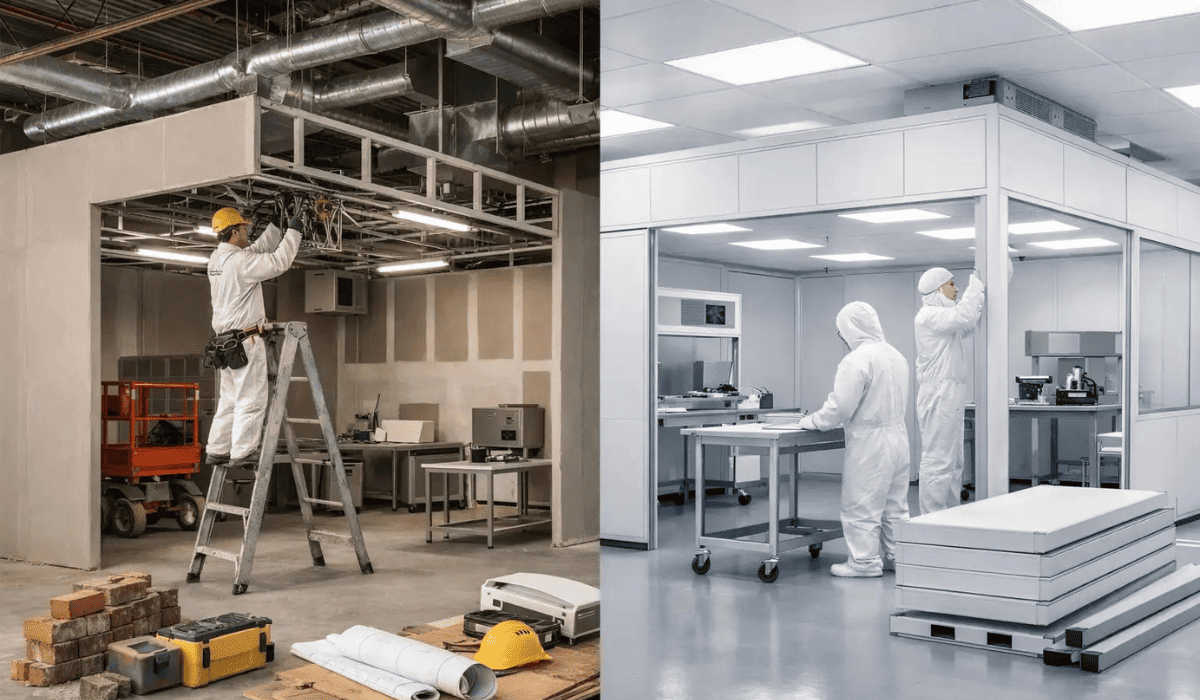
Businesses planning a new cleanroom often need to decide between a modular cleanroom and a traditional cleanroom.
Both options can support contamination control, ISO classifications, and industry-specific requirements, but they differ in how they are designed, built, installed, and expanded.
The right choice depends on several factors, including project timeline, budget, flexibility needs, facility layout, and long-term growth plans.
Some businesses need a cleanroom quickly and prefer the faster installation of modular systems, while others need a highly customized environment that is integrated into a larger facility.
Understanding the differences between modular and traditional cleanrooms can help businesses choose the right solution for their operations.
What Is a Modular Cleanroom?
A modular cleanroom is built using prefabricated components such as wall panels, ceiling systems, windows, doors, lighting, and structural framing.
These cleanrooms are manufactured in sections and assembled on-site.
Because many components are pre-engineered, modular cleanrooms can often be installed faster than traditional cleanrooms.
Modular cleanrooms are commonly used in:
- Pharmaceutical manufacturing
- Medical device production
- Laboratory environments
- Electronics assembly
- Aerospace facilities
- Food processing
- Research and development spaces
They can be designed to meet a wide range of ISO classifications and are often used when speed, flexibility, and future expansion are important.
What Is a Traditional Cleanroom?
A traditional cleanroom, sometimes called a stick-built cleanroom, is constructed directly within the building using conventional construction methods.
These cleanrooms are often built with:
- Permanent walls
- Drywall or gypsum systems
- Fixed HVAC systems
- Permanent ceilings
- Custom utilities
- Integrated building infrastructure
Traditional cleanrooms are usually designed as a permanent part of the facility and are often chosen for large-scale manufacturing operations or highly specialized environments.
Because they are built into the building itself, traditional cleanrooms may allow for more customization, but they often take longer to complete.
Installation Speed Comparison
One of the biggest differences between modular and traditional cleanrooms is installation speed.
Modular cleanrooms are typically faster to install because the components are prefabricated before they arrive on-site.
Once the materials are delivered, the cleanroom can often be assembled quickly with less disruption to the surrounding facility.
In many cases, modular cleanrooms can be completed in a matter of weeks depending on the project size and complexity.
Traditional cleanrooms usually take longer because they involve more on-site construction, framing, drywall work, finishing, HVAC installation, and inspections.
Large traditional cleanroom projects may take several months to complete, especially if they involve structural changes or highly customized features.
For businesses that need a cleanroom quickly, modular systems are often the faster option.
Cost Comparison
Cost is another major factor when comparing modular and traditional cleanrooms.
Modular cleanrooms are often more cost-effective because they use standardized components and require less on-site labor. Faster installation can also help reduce project costs by limiting downtime and minimizing disruption.
Modular cleanrooms may offer cost savings in areas such as:
- Shorter installation timelines
- Reduced labor costs
- Lower construction waste
- Easier future modifications
- Less facility disruption
Traditional cleanrooms may have higher construction costs because they often involve more labor, longer schedules, custom finishes, and larger HVAC systems.
However, traditional construction may still be the right investment for businesses that need a permanent, highly customized environment with integrated utilities and building systems.
The total cost of either option depends on factors such as ISO classification, room size, HVAC requirements, utility needs, filtration systems, and regulatory compliance.
Flexibility and Expansion
Flexibility is one of the main advantages of modular cleanrooms.
Because modular cleanrooms are built using prefabricated panels and structural systems, they are often easier to modify, expand, relocate, or reconfigure in the future.
For example, a company may need to add more production space, install additional equipment, or create separate clean zones as operations grow.
Modular cleanrooms make these changes easier because wall panels and ceiling sections can often be removed or reconfigured without major construction.
Traditional cleanrooms are usually more difficult to modify because they are permanently integrated into the building structure.
Expanding a traditional cleanroom may require demolition, new construction, HVAC redesign, and additional permits.
Businesses that expect future growth or changing production needs often prefer modular cleanrooms because of this added flexibility.
Facility Disruption During Construction
Construction disruption can be an important concern for businesses that need to continue operating while a cleanroom is being installed.
Modular cleanrooms usually create less disruption because much of the fabrication happens off-site. Installation can often be completed faster, with fewer workers and less demolition.
This can be especially important in active facilities where ongoing production, laboratory work, or manufacturing operations must continue during construction.
Traditional cleanroom construction can be more disruptive because it involves more extensive on-site work, including framing, drywall installation, utility modifications, HVAC work, and finishing.
Longer construction timelines may also increase the risk of noise, dust, and operational interruptions.
For businesses that want to minimize disruption, modular cleanrooms are often a more practical solution.
Customization and Design Options
Traditional cleanrooms are often seen as more customizable because they are designed specifically for the building and the process.
They may be better suited for:
- Large manufacturing facilities
- Complex process flows
- Specialized utilities
- Custom room layouts
- Permanent infrastructure
- Large-scale pharmaceutical production
However, modular cleanrooms can also support a wide range of design features, including:
- Multiple room configurations
- Gowning rooms
- Pass-through chambers
- Airlocks
- Viewing windows
- Custom lighting
- Specialized wall finishes
- Different ISO classifications
Today’s modular cleanroom systems can be highly customized and are often suitable for many industries and applications.
The best choice depends on the specific goals of the project and the level of customization required.
HVAC and Filtration Considerations
Both modular and traditional cleanrooms require carefully designed HVAC and filtration systems.
Cleanroom HVAC systems are responsible for:
- Airflow control
- Particle removal
- Pressure control
- Temperature regulation
- Humidity control
- Air changes per hour
Modular cleanrooms often use integrated HVAC systems that are designed specifically for the cleanroom layout.
Traditional cleanrooms may use larger, building-wide HVAC systems that are permanently connected to the facility infrastructure.
Both options can support HEPA or ULPA filtration depending on the ISO classification and contamination control requirements.
The decision between modular and traditional construction does not eliminate the need for proper HVAC design. Both systems must be engineered carefully to maintain cleanroom performance and support certification.
Long-Term Maintenance
Maintenance is another important factor to consider.
Modular cleanrooms often make maintenance easier because wall panels, ceiling systems, and utilities may be easier to access and replace.
If a section of the cleanroom becomes damaged, individual panels or components can often be removed and replaced without major demolition.
Traditional cleanrooms may require more extensive repair work if walls, ceilings, or utility systems need to be modified.
However, both types of cleanrooms require routine maintenance for HVAC systems, filters, doors, seals, lighting, and environmental controls.
Long-term maintenance costs depend more on the complexity of the cleanroom and the cleanliness requirements than on whether the system is modular or traditional.
Which Option Is Better?
Neither modular nor traditional cleanrooms are automatically better in every situation.
Modular cleanrooms are often the better choice for businesses that need:
- Faster installation
- Lower construction costs
- Future flexibility
- Easier expansion
- Reduced disruption
- Relocatable cleanroom systems
Traditional cleanrooms are often the better choice for businesses that need:
- Permanent infrastructure
- Highly customized layouts
- Complex utility systems
- Large-scale manufacturing environments
- Integration with existing building systems
The best cleanroom solution depends on the specific needs of the facility, the industry requirements, and the long-term operational goals.
Conclusion
Both modular and traditional cleanrooms can provide effective contamination control and support a wide range of ISO classifications.
The right choice depends on the project timeline, budget, flexibility needs, and level of customization required.
Modular cleanrooms are often preferred for their faster installation, lower disruption, and ability to adapt to future changes.
Traditional cleanrooms may be better suited for highly customized, permanent environments with complex infrastructure requirements.
Ultrapure Technology helps businesses evaluate modular and traditional cleanroom options based on their facility layout, production needs, compliance requirements, and long-term growth plans.
Choosing the right cleanroom solution from the beginning can improve efficiency, control costs, and support future operations.
FAQs
Are modular cleanrooms less expensive than traditional cleanrooms?
Modular cleanrooms are often more cost-effective because they use prefabricated components and require less on-site labor. Faster installation can also help reduce downtime and overall project expenses.
Can modular cleanrooms be expanded in the future?
Modular cleanrooms are designed for flexibility and can often be expanded, reconfigured, or relocated as business needs change. This makes them a practical option for growing operations.
Do modular cleanrooms meet the same ISO standards as traditional cleanrooms?
Both modular and traditional cleanrooms can be designed to meet the same ISO classifications and industry regulations. The HVAC system, filtration, airflow, and room design determine the final cleanroom performance.
Which type of cleanroom installs faster?
Modular cleanrooms typically install faster because many components are prefabricated before arriving on-site. Traditional cleanrooms usually take longer due to more extensive construction and finishing work.
Are traditional cleanrooms better for large facilities?
Traditional cleanrooms are often a better fit for large-scale facilities with permanent infrastructure, complex utilities, and highly customized layouts. They are commonly used for pharmaceutical manufacturing and large production environments.
Which cleanroom option causes less disruption during construction?
Modular cleanrooms usually create less disruption because much of the fabrication is completed off-site. This can help businesses continue operating while the cleanroom is being installed.


