
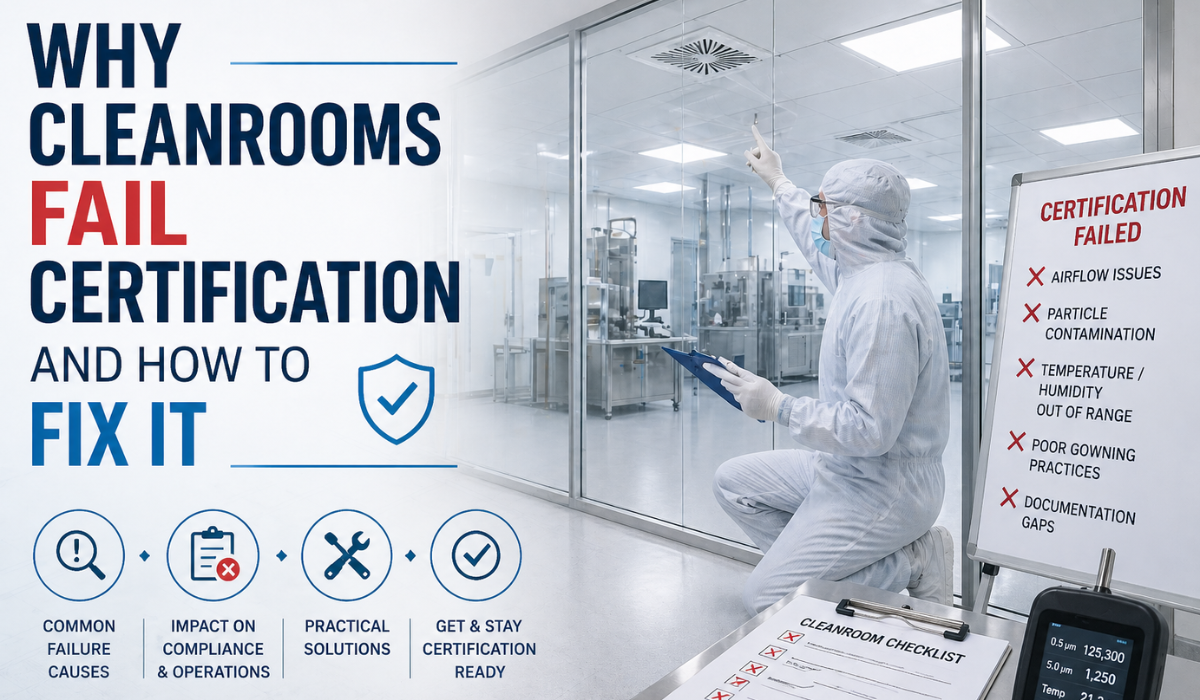
Cleanroom certification is one of the most important steps in the cleanroom construction process.
A cleanroom may look complete on the surface, but if it does not meet required performance standards for airflow, filtration, pressure, cleanliness, temperature, or humidity, it may fail certification testing.
When that happens, the cleanroom cannot be used until the problems are identified and corrected.
For businesses investing in cleanroom construction, certification delays can lead to lost production time, higher costs, and operational setbacks.
This is why it is important to work with experienced professionals throughout both the construction and testing process.
A properly designed cleanroom that is built and validated correctly is far more likely to pass certification the first time.
Cleanroom certification failures can happen for many reasons.
Some issues are minor and easy to fix, while others may require major changes to HVAC systems, room layouts, or contamination control procedures.
Understanding the most common reasons for certification failure can help businesses prevent delays and maintain compliance.
Common Reasons Cleanrooms Fail Certification
Cleanrooms are tested against specific performance requirements based on their ISO classification and industry standards.
If the cleanroom does not meet those standards, it may fail certification. Some of the most common reasons for cleanroom certification failure include:
- Excessive airborne particle counts
- Poor airflow balance
- Inadequate air changes per hour
- Incorrect room pressure relationships
- HEPA or ULPA filter leaks
- Temperature or humidity control issues
- Improper equipment placement
- Construction defects
- Contamination from personnel or materials
- Poor maintenance practices
Many of these issues are connected to the cleanroom’s HVAC and filtration systems, which play a major role in maintaining cleanliness levels and environmental control.
Excessive Airborne Particle Counts
One of the most common reasons a cleanroom fails certification is because particle counts exceed the acceptable limit for the required ISO classification.
Particle counts are measured during certification testing to determine whether the cleanroom is maintaining the proper level of cleanliness.
If too many particles are present in the air, the room may fail. High particle counts can be caused by:
- Leaking filters
- Poor sealing around doors or wall panels
- Dirty surfaces
- Construction debris
- Inadequate cleaning before testing
- Personnel movement
- Improper gowning procedures
- Equipment generating particles
Even a newly built cleanroom can fail particle count testing if the room was not thoroughly cleaned before certification or if contamination entered the space during construction.
To fix this issue, the cleanroom should be cleaned again, filters should be inspected, and all possible contamination sources should be identified and removed.
In some cases, airflow adjustments may also be necessary to improve particle removal.
HVAC System Problems
HVAC systems are one of the most important components of any cleanroom.
If the HVAC system is not functioning properly, the cleanroom may struggle to maintain airflow, pressure, temperature, humidity, and particle control.
Common HVAC-related certification failures include:
- Inadequate airflow volume
- Poor air balancing
- Incorrect pressure differentials
- Inconsistent temperature control
- Humidity outside acceptable limits
- Insufficient air changes per hour
A cleanroom depends on a carefully engineered HVAC system to support its required ISO classification.
If the system is undersized, improperly installed, or poorly balanced, the room may fail multiple parts of the certification process.
For example, if the cleanroom does not maintain positive pressure relative to surrounding spaces, contaminated air may enter the room.
If humidity levels are too high, it can create problems for sensitive manufacturing or laboratory processes.
Correcting HVAC issues often requires balancing airflow, adjusting dampers, recalibrating controls, repairing ductwork, or upgrading equipment.
This is why proper HVAC design is critical during cleanroom construction.
HEPA and ULPA Filter Leaks
HEPA and ULPA filters are responsible for removing airborne contaminants from the cleanroom environment.
If these filters leak or are not installed correctly, contaminated air can bypass the filtration system and enter the cleanroom.
Filter leaks are often found during integrity testing, which is a standard part of cleanroom certification.
Common causes of filter-related failures include:
- Damaged filter media
- Improper filter installation
- Gaps around filter frames
- Worn gaskets
- Poor sealing around ceiling grids
- Damaged housing units
Even small leaks can cause a cleanroom to fail certification, especially in environments with strict cleanliness requirements.
To correct this issue, damaged filters may need to be replaced, seals may need to be repaired, and the filter housing system may need to be re-tested to ensure there are no leaks.
Airflow and Pressure Problems
Proper airflow and room pressurization are essential for contamination control.
Cleanrooms are designed to move air in a specific way to remove particles and prevent contaminants from entering critical spaces.
If airflow patterns are disrupted, dead spots may form where particles can accumulate. If room pressure relationships are incorrect, contaminated air may move into cleaner areas.
Common airflow and pressure problems include:
- Uneven airflow distribution
- Turbulent airflow
- Blocked vents or returns
- Improper fan speeds
- Pressure loss between adjacent rooms
- Air leakage through doors or wall penetrations
For example, a gowning room may need to remain at a different pressure than the cleanroom itself. If pressure relationships are not maintained, the cleanroom may fail certification.
Corrective actions often involve rebalancing the HVAC system, sealing air leaks, repositioning equipment, or adjusting fan settings to improve airflow consistency.
Poor Cleanroom Layout or Equipment Placement
Cleanroom design and equipment placement can also affect certification results.
If large pieces of equipment block airflow or create particle-generating zones, the cleanroom may struggle to maintain cleanliness standards.
Common layout-related issues include:
- Equipment blocking supply vents
- Poor placement of return air grilles
- Congested workspaces
- Improper traffic flow
- Lack of separation between clean and dirty activities
- Inadequate gowning or staging areas
Cleanroom design should support smooth movement of personnel, materials, and equipment while minimizing contamination risks.
If the layout creates bottlenecks or disrupts airflow, the room may fail testing.
Fixing this issue may require moving equipment, redesigning traffic flow, adding barriers, or adjusting air return locations.
Construction Defects and Installation Errors
In some cases, cleanroom certification failures are caused by construction defects or installation mistakes.
Even small gaps, cracks, or unfinished areas can allow contamination to enter the cleanroom.
Common construction-related issues include:
- Gaps between wall panels
- Poorly sealed doors and windows
- Cracks around utility penetrations
- Damaged flooring
- Loose ceiling panels
- Unsealed light fixtures
- Improperly installed pass-through chambers
Construction quality plays a major role in long-term cleanroom performance.
A cleanroom that is built without proper sealing and attention to detail may experience recurring certification problems over time.
Corrective actions may include resealing joints, repairing damaged finishes, replacing worn gaskets, or improving the installation of cleanroom components.
Operational and Maintenance Problems
Even if a cleanroom passes certification initially, it may fail future testing if maintenance and operational practices are not followed properly.
Common operational causes of certification failure include:
- Dirty filters
- Lack of preventive maintenance
- Poor cleaning procedures
- Improper gowning practices
- Excessive room occupancy
- Inadequate staff training
- Delayed equipment repairs
Cleanrooms require ongoing maintenance to keep systems functioning properly.
Filters must be replaced regularly, HVAC systems must be inspected, and personnel must follow contamination control procedures.
Without proper maintenance, a cleanroom that once met certification standards can gradually develop problems that affect performance.
How to Prevent Cleanroom Certification Failures
The best way to avoid certification failures is to address potential issues early during cleanroom construction and design.
Businesses can reduce the risk of delays by:
- Working with experienced cleanroom construction professionals
- Designing HVAC systems correctly from the beginning
- Selecting the right filtration systems
- Performing thorough cleaning before testing
- Conducting pre-certification inspections
- Training staff on contamination control procedures
- Maintaining filters, HVAC systems, and seals regularly
- Scheduling routine cleanroom testing and validation
A proactive approach can help identify problems before they affect certification results.
Conclusion
Cleanrooms fail certification for many different reasons, but most issues can be traced back to airflow, filtration, pressure control, contamination, construction quality, or maintenance practices.
Identifying these problems early can help businesses avoid costly delays and keep projects on schedule.
Proper cleanroom construction, careful HVAC design, and routine cleanroom testing and validation all play a critical role in certification success.
By working with experienced professionals and addressing issues before testing begins, businesses can improve their chances of passing certification the first time and maintaining long-term cleanroom performance.
FAQs
What causes a cleanroom to fail certification most often?
High particle counts, poor airflow, incorrect pressure, leaking filters, and temperature or humidity issues are the most common causes. Construction defects and poor maintenance can also lead to certification failures.
Can a cleanroom fail certification even if it is newly built?
Yes, newly built cleanrooms can fail if they are not cleaned properly, if filters leak, or if HVAC systems are not balanced correctly. Small gaps or airflow issues can also affect results.
How are HEPA filter leaks found during certification?
HEPA filter leaks are found during filter integrity testing. Technicians inspect for damage, gaps, worn seals, or poor installationcleanroom certification failure that could let contaminated air pass through.
Why is airflow so important in a cleanroom?
Airflow helps control particle movement and remove contaminants from the space. Poor airflow can create areas where particles build up and increase the risk of certification failure.


