
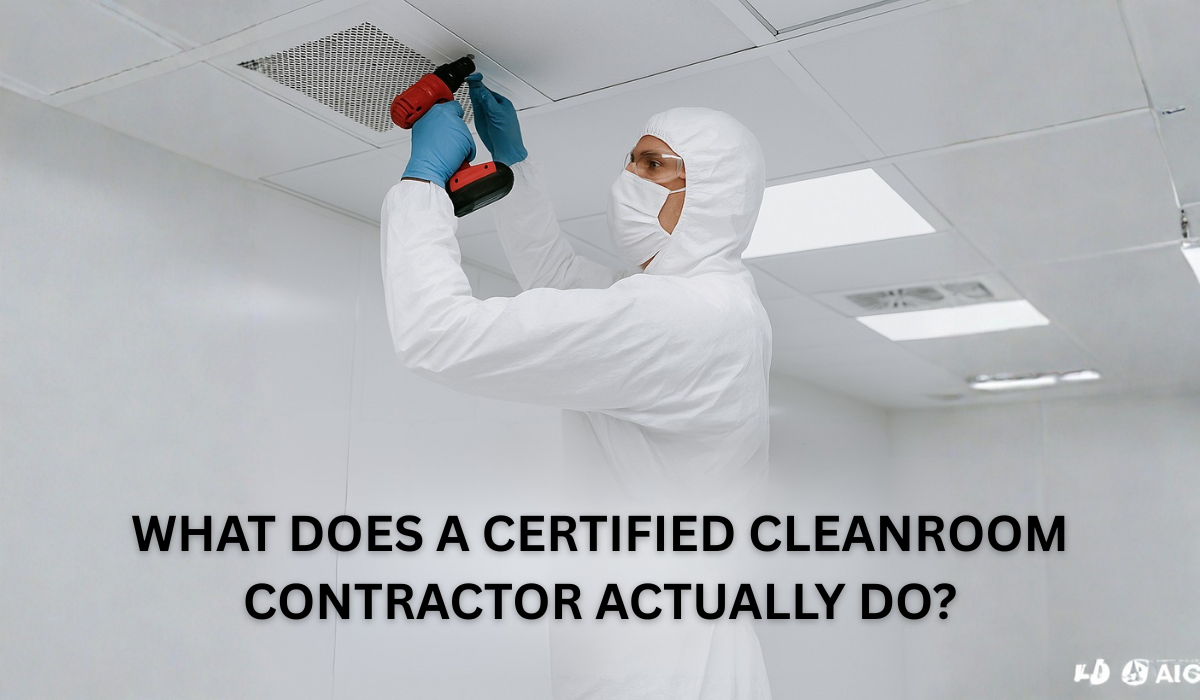
If you’re planning a cleanroom project — whether for pharmaceuticals, biotech, microelectronics, medical devices, aerospace, EV batteries, or research labs — one of the first questions that comes up is:
“What exactly does a certified cleanroom contractor do?”
You might assume they simply build walls, install filters, and add specialized HVAC systems. But the truth is, cleanroom contractors handle far more than construction. They manage compliance, engineering, airflow validation, material selection, safety standards, HVAC balancing, and long-term performance.
A certified cleanroom contractor is responsible for delivering a fully functioning, ISO-compliant environment that protects your products, processes, and workers. And in industries where a single particle, microbe, or moisture trace can ruin a batch — experience matters.
In this article, we break down what cleanroom contractors actually do, why certification is important, and how the right partner ensures your cleanroom is safe, compliant, and production-ready from day one.
What Exactly Is a Certified Cleanroom Contractor?
A certified cleanroom contractor is a specialized company trained to design, build, install, and validate controlled environments that meet strict standards like:
- ISO 14644
- cGMP and EU-GMP
- FDA (21 CFR Part 210/211)
- AS9100 (aerospace)
- SEMI S2 (microelectronics/semiconductors)
- NFPA and OSHA safety codes
These contractors understand the science behind contamination control — airflow, pressure, filtration, vibration, temperature, humidity, electrostatic discharge (ESD), and material behavior — to build rooms where the environment stays stable and clean.
This includes cleanrooms for:
- Pharmaceuticals
- Biotech & life sciences
- Medical devices
- Microelectronics & semiconductors
- Aerospace & optical systems
- EV battery & energy storage
- Research laboratories
- Food, packaging, and industrial manufacturing
Cleanroom contractors handle every step, from early design to construction to validation — meaning you get a complete, turnkey environment ready for inspection or operation.
What Does a Cleanroom Contractor Actually Do?
1. They Analyze Your Requirements & Compliance Needs
Before designing anything, a certified cleanroom contractor learns about your:
- Industry and regulations
- Process flow
- Equipment requirements
- Product sensitivity
- ISO class or GMP grade
- Budget and timeline
- Future expansion plans
This ensures the cleanroom is built for your exact needs, not a generic template.
For example:
- Pharma clients may need GMP-grade airlocks and easy-to-clean surfaces.
- Semiconductor clients may need ISO 5 laminar airflow and vibration control.
- EV battery manufacturers require ultra-dry rooms with dew point –40°C.
This discovery phase sets the foundation for a safe, compliant build.
2. They Handle Cleanroom Design & Engineering
Once requirements are understood, engineers create a detailed design package, including:
- Full cleanroom layout
- Airflow modeling
- Pressure cascade diagrams
- HVAC and filtration design
- Electrical and plumbing planning
- Process workflow mapping
- Gowning, material flow, and contamination pathways
- Safety and fire protection planning
Cleanroom contractors use engineering tools to ensure:
- No dead-air zones
- Proper filtration
- Correct pressure differentials between rooms
- Controlled temperature & humidity
- ESD protection where needed
- Energy efficiency
- Compliance with ISO, GMP, and safety standards
A good design reduces contamination risks and improves long-term performance.
3. They Select the Right Materials & Components
Certified cleanroom contractors know which materials are best for:
- Particle control
- Air sealing
- Moisture resistance
- ESD stability
- Chemical resistance
- Cleanability
Common materials include:
- Powder-coated aluminum panels
- FRP or HPL modular walls
- Stainless steel fixtures
- Seamless epoxy flooring
- PVC or aluminum ceiling grids
- Air-tight doors & pass-through chambers
Choosing the wrong materials can cause outgassing, shedding, corrosion, or contamination — which is why certified contractors make every choice carefully.
4. They Manage Modular Cleanroom Construction or Hardwall Build
Depending on your needs, contractors build:
- Modular cleanrooms
- Hardwall cleanrooms
- Dry rooms
- Softwall cleanrooms
- Hybrid systems
Their work includes:
- Installing wall panels & ceiling grids
- Integrating HEPA/ULPA filters
- Running electrical, data, and plumbing lines
- Installing temperature & humidity systems
- Sealing gaps
- Installing flooring and pass-throughs
- Building gowning rooms & airlocks
They follow strict protocols to prevent contamination during construction, using controlled procedures, PPE, and dust mitigation.
5. They Install HVAC, Filtration & Airflow Systems
Cleanrooms depend on precise environmental control, so contractors build and install:
- HEPA/ULPA filtration systems
- Laminar flow units
- Air handlers
- Ducting & diffusers
- Temperature & humidity control systems
- Differential pressure monitors
- Desiccant dehumidifiers (for dry rooms)
This ensures:
- Clean air enters the room
- Dirty air is swept out
- Airflow stays consistent
- ISO class is maintained
This is the heart of contamination control.
6. They Perform Testing, Validation & Certification
A cleanroom isn’t complete until it passes validation testing, including:
- Airflow velocity & uniformity tests
- HEPA/ULPA filter integrity (DOP/PAO)
- Particle count (for ISO class)
- Temperature & humidity stability
- Pressure differentiation
- ESD testing
- Light, sound, and vibration checks
- Recovery time testing
Only after passing these tests is the cleanroom certified for operation.
7. They Provide Documentation for Audits (ISO, FDA, GMP, etc.)
Certified cleanroom contractors deliver full documentation including:
- Design drawings
- HVAC schematics
- Pressure & airflow diagrams
- Validation reports
- Material specifications
- Compliance statements
- Maintenance manuals
This documentation is critical for:
- FDA audits
- ISO 14644 audits
- GMP inspections
- Internal quality control
A non-certified contractor often cannot provide this.
8. They Support Maintenance, Repairs & Re-Certification
Cleanrooms need ongoing:
- Air testing
- Filter replacement
- Performance calibration
- Pressure adjustments
- Environmental monitoring
Certified contractors provide annual re-certification, ensuring long-term compliance.
Why Working With a Certified Cleanroom Contractor Matters
You’re not just buying walls and filters — you’re buying:
- ISO compliance
- FDA/GMP readiness
- Performance stability
- Safety
- Reliability
- Long-term protection
A non-certified contractor may build something that looks like a cleanroom — but can’t pass validation or meet regulatory standards.
A certified contractor ensures:
- The design is correct
- The materials match your industry
- The environment meets your ISO class
- Air systems actually work
- You pass audits
- Your cleanroom remains stable for years
For industries where failure is expensive — pharmaceuticals, semiconductors, aerospace, and EV batteries — this is essential.
Why Choose Ultrapure Technology as Your Cleanroom Contractor
Ultrapure Technology provides:
- 30+ years of industry experience
- Turnkey design, build, install, and validate services
- Modular cleanroom systems
- FDA, GMP, and ISO-compliant construction
- Dry rooms, semiconductor cleanrooms, pharma suites, and more
- In-house engineers and certified technicians
- Fast timelines with proven project management
- Full documentation & re-certification services
We ensure your cleanroom is:
- Safe
- Compliant
- Efficient
- Validated
- Future-ready
From start to finish — Ultrapure delivers.
Final Thoughts
A certified cleanroom contractor doesn’t just build a room — they deliver a controlled environment engineered for safety, compliance, and performance.
From design and airflow mapping to installation and certification, every step impacts the final outcome. That’s why choosing the right partner is critical.
Ultrapure Technology specializes in building world-class cleanrooms that meet the highest standards across pharmaceuticals, biotech, aerospace, semiconductors, EV batteries, and more.
If you want a cleanroom that’s built right the first time — we can help.
📢 CTA Section
Build Your ISO-Certified Cleanroom With Ultrapure Technology
Ultrapure Technology provides turnkey cleanroom design, construction, installation, and certification for the most demanding industries.
From concept to completion, we ensure full compliance with ISO 14644, GMP, FDA, SEMI, and aerospace standards.
👉 Request your Cleanroom Consultation Today
Frequently Asked Questions (FAQs)
Why do I need a certified cleanroom contractor instead of a general contractor?
A general contractor may understand construction, but cleanrooms require precision engineering, contamination control, airflow balancing, environmental stability, and ISO/GMP compliance. Certified cleanroom contractors specialize in air handling, pressure zoning, HEPA/ULPA filtration, and validation. Without them, your cleanroom may not pass certification or meet industry regulations, causing expensive delays and redesigns.
How long does it take a contractor to build a fully certified cleanroom?
The timeline depends on size, ISO class, and complexity. Smaller modular cleanrooms may take 2–6 weeks, while large pharmaceutical or semiconductor facilities may take 3–6 months. Cleanroom contractors handle design, material procurement, installation, HVAC integration, and testing — ensuring every environmental parameter meets certification standards before delivery.
What industries require certified cleanroom contractors?
Certified cleanroom contractors work across industries where contamination, moisture, or static can damage products. This includes pharmaceuticals, biotech, microelectronics, aerospace, medical devices, EV batteries, food processing, research labs, and optical systems. Each industry has unique standards, and certified contractors tailor the design and build to meet those specific requirements.
How do contractors ensure the cleanroom meets ISO or GMP standards?
Certified contractors design the cleanroom around airflow patterns, filtration levels, pressure control, surface materials, HVAC zoning, and contamination flow. They perform validation testing — including particle counts, pressure mapping, airflow measurements, humidity/temperature checks, and filter integrity tests — to verify compliance. They then provide documentation for ISO or FDA audits.
What happens after the cleanroom is built — do contractors help with maintenance?
Yes. Professional cleanroom contractors provide ongoing maintenance, including filter replacement, airflow balancing, environmental monitoring, and annual re-certification. Cleanrooms must remain ISO-compliant year-round, so routine service ensures long-term performance and reliability. Many companies sign maintenance agreements for continuous support.
