
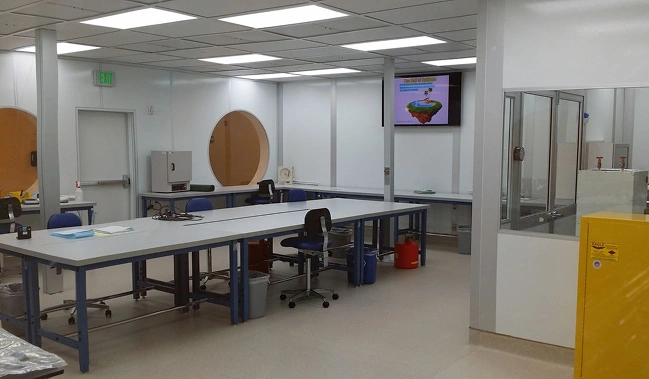
Cleanroom over-engineering is one of the most common and costly challenges facing modern controlled environments.
In an effort to reduce risk, many cleanrooms are designed far beyond what their actual process requirements demand.
While compliance and contamination control remain critical, excessive engineering can drive up capital costs, energy usage, and long-term operational expenses without delivering measurable improvements in performance or regulatory outcomes.
Understanding how to balance cleanroom design requirements with real-world process needs is essential for creating facilities that are efficient, compliant, and scalable.
This article explores why over-engineering happens, how it impacts cleanroom lifecycle costs, and how a right-sized engineering approach improves operational efficiency while maintaining industry standards.
What Is Cleanroom Over-Engineering?
Cleanroom over-engineering occurs when a controlled environment is designed with performance specifications that exceed what the manufacturing or research process actually requires.
This may include higher cleanroom classification levels, excessive air changes per hour, or redundant HVAC systems that add complexity without improving contamination control.
In many cases, over-engineering is driven by caution rather than necessity.
While conservative design choices may feel safer, they often result in increased cleanroom engineering costs and operational inefficiencies over time.
Why Cleanrooms Are Often Designed Beyond What’s Necessary
Risk Aversion in Regulated Industries
Industries such as pharmaceuticals, biotechnology, and semiconductor manufacturing operate under strict regulatory oversight.
To avoid compliance failures, design teams may adopt a “more is better” mindset, assuming that higher ISO cleanroom standards automatically reduce risk.
Misinterpretation of ISO Cleanroom Standards
ISO cleanroom standards define allowable particle concentrations, not mandatory design targets.
Designing every space to the highest classification level can lead to unnecessary complexity when lower classifications would still meet contamination control strategies.
Legacy and Copy-Paste Designs
Many cleanrooms are based on previous projects rather than process-specific analysis.
Reusing outdated layouts or airflow strategies often leads to systems that no longer align with modern equipment, workflows, or production volumes.
Cleanroom Design Requirements vs Actual Process Needs
Understanding the Process Environment
Effective cleanroom design begins with understanding where contamination risks originate.
Personnel movement, material transfer, and equipment operation often contribute more particles than the process itself.
Without this insight, designers may overspecify cleanroom airflow design or filtration systems.
Matching Cleanroom Classification to Risk
Not every operation requires high-level cleanroom classification levels.
ISO Class 7 or 8 environments are sufficient for many manufacturing steps, while ultra-clean classifications should be reserved for truly sensitive processes.
The Hidden Costs of Cleanroom Over-Engineering
Increased Capital Expenditure
Over-engineered cleanrooms require larger HVAC systems, additional HEPA or ULPA filters, and more robust structural components.
These elements significantly increase upfront construction costs.
Higher Operational and Energy Costs
Excessive air change rates drive continuous energy consumption.
HVAC systems for cleanrooms are already energy-intensive, and oversizing them amplifies utility expenses year after year.
Maintenance and Lifecycle Burden
More complex systems demand frequent maintenance, filter replacements, and recertification.
Over time, cleanroom lifecycle costs often far exceed the original construction budget.
How Cleanroom Engineering Impacts Industry Standards
Cleanroom engineering decisions directly affect validation, monitoring, and compliance outcomes.
Over-engineering does not improve audit results if systems are poorly matched to actual process controls.
Regulatory bodies prioritize consistency, documentation, and risk management not excessive performance margins.
Well-aligned cleanroom validation and compliance strategies focus on demonstrating control rather than exceeding unnecessary benchmarks.
Right-Sizing Cleanrooms for Efficiency and Compliance
Right-sizing cleanrooms is a critical strategy for achieving both operational efficiency and regulatory compliance.
Rather than designing every space to the highest possible cleanroom classification, modern facilities benefit from aligning cleanroom design requirements with actual process risks.
This approach reduces unnecessary capital investment, lowers energy consumption, and simplifies long-term maintenance while maintaining required contamination control standards.
A right-sized cleanroom supports consistent performance by delivering the level of environmental control needed for each specific operation no more and no less.
When engineering decisions are driven by process data instead of assumptions, facilities gain greater flexibility, improved efficiency, and more predictable compliance outcomes.
Risk-Based Cleanroom Design
A risk-based cleanroom design and build approach begins with a detailed evaluation of contamination sources, process sensitivity, and operational frequency.
This assessment identifies where particles are most likely to be generated and how they may impact product quality or process integrity.
By focusing on real-world conditions, designers can determine appropriate cleanroom classification levels and airflow requirements that directly support the process.
This method ensures that cleanroom design requirements are aligned with actual production risks rather than theoretical worst-case scenarios.
Instead of assuming maximum contamination potential at all times, risk-based design considers variables such as personnel movement, equipment operation, material handling, and process duration.
The result is a controlled environment that meets regulatory expectations while avoiding unnecessary system complexity.
Zoning and Segmentation Strategies
Zoning and segmentation are essential tools for right-sizing cleanrooms without compromising protection.
Rather than upgrading an entire facility to a single high classification, designers can apply higher levels of control only in areas where contamination risk is greatest.
This targeted approach limits system size while maintaining effective contamination control.
Pressure differentials, localized airflow, and controlled zones help prevent cross-contamination between areas with different cleanliness requirements.
For example, critical processing zones may operate under higher positive pressure, while adjacent support spaces maintain lower classifications.
These strategies reduce HVAC loads, improve airflow stability, and support efficient cleanroom operation while remaining fully compliant with applicable standards.
Cleanroom Airflow Design and Filtration Optimization
Appropriate Air Change Rates
Higher air changes per hour do not always improve cleanliness.
Excessive airflow can create turbulence that redistributes particles instead of removing them.
Strategic Filter Placement
Optimizing HEPA coverage based on activity zones ensures effective contamination control strategies without redundant filtration.
Optimizing Cleanroom Design for Different Industry Needs
Cleanroom requirements vary significantly across industries, driven by differences in product sensitivity, regulatory oversight, and process complexity.
Although, contamination control is a shared priority, the level of environmental control needed is not the same for every application.
Designing cleanrooms without considering these distinctions often leads to unnecessary over-engineering, increased operating costs, and reduced system efficiency.
Optimizing cleanroom design for different industry needs requires a clear understanding of how particles, airflow, personnel, and equipment interact within each process.
By tailoring cleanroom classification levels, airflow strategies, and zoning approaches to specific operational demands, facilities can maintain compliance, protect product integrity, and achieve long-term efficiency without exceeding what the process truly requires.
Pharmaceutical Cleanroom Design
Aseptic processing areas demand precision, but not all pharmaceutical spaces require the same classification.
Separating critical and non-critical zones improves efficiency while maintaining GMP alignment.
Semiconductor Cleanroom Requirements
Semiconductor manufacturing is highly sensitive to particles, but not all tools require identical environments.
Tailored classifications reduce energy demand without compromising yield.
Biotechnology and Medical Device Manufacturing
Flexible, modular cleanroom design supports changing processes and mixed-use environments without permanent overbuilding.
Modular and Scalable Cleanroom Design Solutions
Modular cleanroom design has become an increasingly effective solution for facilities seeking flexibility without compromising compliance or performance.
In compared to traditional stick-built cleanrooms, modular systems are engineered as standardized components that can be assembled, reconfigured, or expanded as operational requirements change.
This adaptability makes modular cleanrooms especially valuable in industries where processes evolve, production volumes fluctuate, or new technologies are introduced.
By allowing facilities to scale cleanroom environments incrementally, modular cleanroom design helps avoid the risk of permanent overbuilding.
Instead of investing upfront in capacity that may not be needed for years, organizations can align cleanroom design requirements with current production demands while maintaining a clear path for future expansion.
Supporting Compliance Through Flexible Design
Modular cleanrooms are designed to meet established ISO cleanroom standards and industry-specific regulatory requirements.
Panels, ceiling systems, and integrated HVAC components are manufactured under controlled conditions, resulting in consistent quality and predictable performance.
This consistency simplifies cleanroom validation and supports repeatable compliance outcomes as systems are modified or expanded.
Because modular systems can be reconfigured without major structural changes, facilities can adapt to updated regulatory expectations or process modifications without triggering extensive reconstruction or downtime.
This flexibility helps maintain compliance while minimizing disruption to ongoing operations.
Cost Efficiency Across the Cleanroom Lifecycle
One of the most significant advantages of modular cleanroom design is its impact on cleanroom lifecycle costs.
Reduced construction time, lower initial material requirements, and streamlined installation processes help control capital expenditures.
Over time, the ability to modify or relocate modular components reduces the cost of future upgrades and facility changes.
From an operational perspective, modular cleanrooms support efficient airflow design and optimized HVAC performance.
Systems can be sized appropriately for each phase of operation, reducing energy consumption and avoiding the inefficiencies associated with oversized infrastructure.
Scalability Without Over-Engineering
Scalable cleanroom solutions allow facilities to grow in step with their processes.
Additional cleanroom space, higher classification zones, or enhanced airflow controls can be introduced only when justified by production needs.
This phased approach preserves flexibility while ensuring contamination control strategies remain aligned with actual risk.
By integrating modular and scalable cleanroom design solutions, organizations can balance compliance, efficiency, and long-term adaptability.
The result is a controlled environment that supports current operations while remaining prepared for future demands without the financial and operational burden of over-engineering.
Cleanroom Validation and Compliance Without Over-Engineering
Cleanroom validation is a critical component of regulatory compliance, confirming that a controlled environment consistently performs as intended and supports product safety, quality, and process integrity.
However, validation success is not achieved by maximum system capacity or the highest cleanroom classification levels.
Instead, it depends on repeatability, documented control, and the ability to demonstrate that environmental conditions remain within defined limits over time.
Designing cleanrooms specifically to support validation rather than excessive performance margins creates systems that are easier to qualify, monitor, and maintain throughout their operational life.
Designing for Consistent Validation Performance
Validation success depends on consistency and documentation, not overbuilt infrastructure.
Cleanrooms with excessively high airflow rates or complex mechanical systems often introduce variability that complicates qualification testing.
Fluctuations in airflow patterns, pressure differentials, or temperature control can make it more difficult to demonstrate stable performance during installation qualification (IQ), operational qualification (OQ), and performance qualification (PQ).
By right-sizing HVAC systems and airflow design to actual process needs, cleanrooms achieve more predictable operating conditions.
Stable systems simplify testing procedures, reduce revalidation risk, and support long-term compliance with applicable ISO cleanroom standards and industry regulations.
Simplifying Monitoring and Control Systems
Cleanrooms that are designed with clarity and simplicity in mind are easier to monitor and control.
Over-engineered environments often require extensive sensor networks, complex control logic, and frequent system adjustments.
While these systems may offer high theoretical performance, they can increase the risk of documentation gaps and operational errors.
Cleanroom designs that prioritize accessibility and straightforward control strategies enable more effective environmental monitoring.
Clear alarm thresholds, manageable data trends, and well-defined corrective actions help ensure that deviations are identified and addressed quickly, supporting ongoing compliance without unnecessary system complexity.
Supporting Long-Term Compliance and Revalidation
Regulatory compliance is an ongoing requirement, not a one-time event.
Cleanrooms must remain in a validated state throughout their lifecycle, even as processes evolve or equipment changes.
Over-engineered systems can make revalidation more resource-intensive, as modifications often trigger extensive testing and documentation updates.
Designing systems that are easy to test, monitor, and maintain improves long-term compliance outcomes.
Modular components, accessible airflow paths, and well-documented control strategies allow facilities to adapt to change while preserving validation integrity.
This approach reduces downtime, limits requalification scope, and supports sustainable cleanroom operation.
Signs Your Cleanroom May Be Over-Engineered
Cleanrooms are designed to maintain controlled conditions that support product quality and regulatory compliance.
However, when systems are engineered far beyond actual process requirements, facilities may experience operational inefficiencies that are often overlooked.
Recognizing the signs of cleanroom over-engineering is an important first step toward optimization, cost control, and improved system performance.
Facilities may be over-engineered if they experience high energy costs, particle counts consistently well below required limits, or controlled spaces that are rarely used at their designed capacity.
These indicators often suggest that system performance exceeds what the process demands, creating opportunities to improve efficiency without compromising compliance.
Excessive Energy Consumption Without Process Justification
One of the most common signs of over-engineering is unusually high energy usage tied to cleanroom operations.
Oversized HVAC systems, excessive air change rates, and continuous operation of high-capacity filtration systems can drive utility costs far beyond what is necessary for effective contamination control.
When energy consumption remains high even during periods of low production or reduced occupancy, it may indicate that airflow and system capacity are not aligned with actual operational needs.
Particle Counts Consistently Far Below Required Limits
While low particle counts may appear beneficial, consistently operating far below required ISO cleanroom standards can signal inefficiency.
Maintaining unnecessarily low particle levels often requires higher airflow rates and increased filtration, which add cost without improving process outcomes.
In many cases, particle data reveals that cleanroom classification levels could be adjusted without increasing risk, allowing facilities to reduce airflow demands while remaining fully compliant.
Underutilized Cleanroom Zones and Equipment
Over-engineered cleanrooms often include large controlled areas that are rarely used at full capacity.
Entire rooms or zones may operate at high classification levels even when equipment is idle or processes are inactive.
This mismatch between space utilization and system performance increases operating costs and complicates maintenance.
Zoning or segmentation strategies can often correct this imbalance by applying higher controls only where and when needed.
Frequent Maintenance Without Performance Gains
Highly complex systems require more frequent maintenance, calibration, and filter replacement.
If maintenance efforts increase without corresponding improvements in cleanliness or process stability, over-engineering may be contributing to unnecessary operational burden.
Simplifying system design can improve reliability and reduce downtime while maintaining effective contamination control.
Difficulty Maintaining Stable Operating Conditions
Over-engineered airflow and pressure systems can introduce instability rather than control.
Excessive air velocity or complex pressure cascades may create turbulence, temperature fluctuations, or inconsistent airflow patterns.
These issues can make environmental conditions harder to manage and validate, signaling that the system may be operating beyond practical requirements.
Identifying Opportunities for Optimization
Recognizing these signs allows facilities to evaluate cleanroom performance objectively.
Energy audits, particle trend analysis, and space utilization reviews often reveal opportunities to optimize airflow, zoning, and system controls.
By aligning cleanroom design requirements with actual process needs, facilities can improve efficiency, reduce costs, and maintain compliance without sacrificing protection or performance.
How to Evaluate and Optimize Existing Cleanrooms
Evaluating existing cleanrooms is an essential step for facilities seeking to reduce operating costs, improve performance, and maintain compliance without unnecessary reconstruction.
Many cleanrooms continue operating as originally designed, even as processes, equipment, and production volumes evolve.
Over time, this misalignment can lead to inefficiencies that are not immediately visible without a structured assessment.
A comprehensive evaluation focuses on how the cleanroom actually performs in daily operation not just how it was designed to perform.
By analyzing system behavior under real-world conditions, facilities can identify targeted improvements that enhance efficiency while preserving contamination control.
Conducting Performance and Compliance Audits
Performance audits provide a clear picture of how well a cleanroom supports its intended process.
These audits typically review particle counts, pressure differentials, temperature stability, and humidity control against required cleanroom classification levels.
When systems consistently exceed performance targets, it may indicate opportunities to reduce airflow or system capacity without increasing risk.
Compliance reviews also assess documentation, monitoring practices, and alarm response procedures.
Cleanrooms that are difficult to document or test often suffer from unnecessary complexity introduced by over-engineering.
Airflow Mapping and Visualization
Airflow mapping is a critical tool for identifying inefficiencies that are not apparent through particle data alone.
Smoke studies and airflow visualization help reveal turbulence, dead zones, or short-circuiting that can undermine contamination control while wasting energy.
By understanding how air actually moves through the cleanroom, engineers can adjust diffuser placement, airflow direction, or air change rates to improve performance without increasing system size.
Energy Analysis and HVAC Optimization
Energy analysis examines how much power cleanroom systems consume relative to their operational requirements.
Oversized HVAC systems, constant-volume airflow, and outdated control strategies often contribute to excessive energy usage.
Optimizing HVAC systems through variable airflow controls, scheduling adjustments, or equipment upgrades can significantly reduce energy demand.
In many cases, these improvements can be implemented without disrupting validated conditions.
Retrofitting and System Recalibration
In many facilities, optimization does not require major reconstruction.
Retrofits such as airflow balancing, pressure cascade adjustments, or control system recalibration can deliver meaningful performance gains with minimal downtime.
These targeted interventions allow cleanrooms to operate closer to actual process needs, reducing operating costs while maintaining compliance and validated performance.
Continuous Improvement Through Ongoing Assessment
Cleanroom optimization is not a one-time effort. Regular reviews of performance data, energy usage, and process changes help ensure that cleanrooms remain aligned with operational demands over time.
By combining performance audits, airflow mapping, and energy analysis, facilities can continuously refine cleanroom operation, achieving efficiency, reliability, and compliance without the burden of over-engineering.
Conclusion
Smarter Cleanroom Design Starts with the Process.
Cleanroom over-engineering may feel like a safe choice, but it often leads to unnecessary complexity and long-term cost burdens.
By aligning cleanroom design requirements with actual process needs, facilities can achieve regulatory compliance, operational efficiency, and sustainable performance.
Optimize Your Cleanroom Engineering Strategy
A process-driven approach to cleanroom engineering delivers measurable value across compliance, efficiency, and lifecycle costs.
Partnering with experienced cleanroom engineering specialists at UltraPure Technology helps ensure your facility is right-sized, validated, and built for long-term success.
Frequently Asked Questions
What is cleanroom over-engineering?
Cleanroom over-engineering occurs when a cleanroom is designed with higher classification levels, airflow, or system capacity than the process actually requires. While well-intentioned, this approach often increases construction and operational costs without improving contamination control or compliance outcomes.
Why does cleanroom over-engineering increase costs?
Over-engineered cleanrooms require larger HVAC systems, higher air change rates, and additional filtration. These elements increase capital expenses, energy consumption, maintenance demands, and long-term lifecycle costs without delivering proportional performance benefits.
Do ISO cleanroom standards require higher classifications by default?
ISO cleanroom standards define allowable particle limits, not mandatory design targets. Many facilities exceed required ISO classifications due to misinterpretation, even though lower classifications would still meet regulatory and process requirements.
How can cleanroom design requirements be matched to actual process needs?
Matching design requirements to process needs starts with evaluating contamination sources, equipment sensitivity, and human activity. A risk-based assessment helps determine appropriate cleanroom classification levels and airflow strategies without unnecessary over-engineering.
Can cleanroom airflow design impact contamination control?
Yes, cleanroom airflow design plays a critical role in contamination control. Excessive airflow can create turbulence that redistributes particles, while properly sized airflow removes contaminants efficiently and supports stable operating conditions.
Are modular cleanroom designs effective in regulated environments?
Modular cleanroom design is widely used in regulated industries because it offers flexibility, scalability, and compliance. These systems allow facilities to adapt to changing processes without overbuilding or redesigning the entire cleanroom.
How does cleanroom over-engineering affect validation and compliance?
Over-engineering does not improve validation outcomes if systems are misaligned with process needs. Regulatory compliance depends on control, consistency, and documentation rather than excessive system capacity or overly high cleanroom classifications.
What are signs that an existing cleanroom may be over-engineered?
Common signs include high energy costs, air change rates well above requirements, consistently low particle counts, and underutilized controlled areas. These indicators suggest opportunities to optimize cleanroom engineering and reduce costs.
Can existing cleanrooms be optimized without major reconstruction?
Many cleanrooms can be optimized through airflow adjustments, zoning changes, and system recalibration. Performance audits and energy assessments often identify improvements that enhance efficiency without requiring full redesign or reconstruction.
