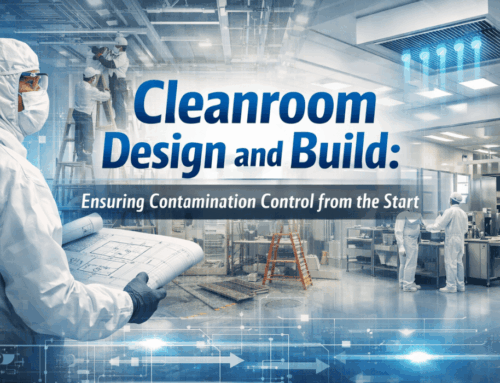
Cleanroom contamination control is the foundation of maximum purity in industries where precision, safety, and compliance are non-negotiable.
Even the smallest particle can become a serious risk, especially in regulated environments.
From pharmaceutical manufacturing to semiconductor fabrication, cleanrooms are engineered to move from unavoidable particle generation to a contamination-free state through strict design, discipline, and monitoring.
Understanding how cleanrooms achieve and maintain maximum purity is essential for anyone responsible for quality, compliance, or operational efficiency.
What Is a Cleanroom and Why Contamination Control Matters
A cleanroom is a controlled environment designed to limit airborne particles, microbes, and chemical contaminants to predefined levels.
Cleanrooms are classified based on the number and size of particles allowed per cubic meter of air, with stricter classifications requiring more advanced controls aligned with cleanroom design standards.
Contamination control is critical because many products and processes are highly sensitive. In pharmaceuticals, contamination can compromise patient safety.
In electronics, microscopic particles can cause circuit failures. In medical device manufacturing, even minor contamination can result in regulatory non-compliance or product recalls. Cleanrooms provide the infrastructure and discipline needed to prevent these outcomes and preserve a consistent contamination-free environment.
Understanding the Sources of Cleanroom Contamination
Maintaining a contamination-free cleanroom begins with understanding where contaminants originate and how they migrate through controlled environments.
Contamination sources are often interconnected, and even small lapses in control can compromise cleanroom performance.
By identifying and managing these sources, facilities can design stronger prevention strategies and maintain consistent compliance.
Airborne Particles
Airborne particles are the most persistent and difficult contamination source to control.
Dust, fibers, aerosols, and microscopic particulates are constantly generated both inside and outside the cleanroom.
Without controlled airflow, these particles can remain suspended in the air, settle on critical surfaces, or be drawn into sensitive processes.
Cleanrooms address this risk through high-efficiency filtration systems and engineered airflow patterns that continuously remove particles from the environment.
Any disruption in airflow balance, filter performance, or pressure differentials can quickly increase contamination levels, making air management and particle control in cleanrooms a top priority.
Personnel
People are the single largest generator of contamination in cleanrooms.
Every movement releases skin flakes, hair, and textile fibers into the surrounding air.
Simple actions such as walking, reaching, or turning can significantly increase particle counts.
To reduce this risk, cleanrooms rely on strict gowning requirements, behavioral guidelines, and training programs.

Proper garments act as a barrier between the individual and the controlled environment, while controlled movement and discipline support stronger cleanroom protocols and reduce contamination spikes.
Surfaces and Equipment
Work surfaces, tools, machinery, and cleanroom furniture can become hidden contamination reservoirs if not properly maintained.
Improperly cleaned or damaged surfaces may shed particles, trap contaminants, or support microbial growth.
Cleanroom-compatible materials are selected to minimize particle release and withstand frequent cleaning with approved disinfectants.
Regular surface cleaning, inspection, and preventive maintenance ensure that equipment does not become a source of contamination over time, supporting reliable cleanroom maintenance.
Material Transfers
Every item introduced into a cleanroom presents a potential contamination risk.
Raw materials, packaging components, tools, and equipment can carry particles, microbes, or residues from uncontrolled environments.
Controlled material transfer processes, such as pass-through chambers, airlocks, and pre-cleaning protocols, help reduce this risk.
Documentation and inspection procedures ensure that only approved and properly prepared materials enter the cleanroom, reducing cross-contamination.
Why Source Identification Matters
Recognizing and understanding these contamination sources is the foundation of effective cleanroom design and operation.
When facilities clearly identify how contaminants enter and spread, they can implement targeted controls rather than relying on reactive cleaning alone.
By addressing airborne particles, personnel behavior, surfaces, and material transfers together, cleanrooms achieve layered contamination defense and stronger cleanroom best practices that support long-term performance and regulatory compliance.
The Science Behind Cleanroom Purity
Controlled Airflow Systems
Cleanrooms rely on carefully engineered airflow patterns to remove contaminants before they can settle.
Laminar airflow moves clean, filtered air in a uniform direction, sweeping particles away from critical areas.
Turbulent airflow, used in less stringent environments, dilutes contamination through high air-change rates.
These engineered cleanroom airflow systems are designed to maintain stability under real-world operating conditions, not just ideal scenarios.
HEPA and ULPA Filtration
High-Efficiency Particulate Air (HEPA) and Ultra-Low Penetration Air (ULPA) filters are the backbone of cleanroom air purification.
These filters capture extremely small particles, ensuring that supplied air meets strict cleanliness requirements.
Pressure Differentials
Positive pressure prevents contaminated air from entering cleaner spaces, while negative pressure is used in hazardous environments to contain contaminants.
Pressure differentials create directional airflow that supports contamination control strategies and keeps cleaner zones protected.
Cleanroom Design Features That Minimize Contamination
Low-Shedding Materials
Walls, ceilings, and floors are constructed from smooth, non-porous materials that resist particle generation and allow easy cleaning.
These decisions are part of the core cleanroom design standards used to reduce long-term contamination risk.
Optimized Layouts
Cleanroom layouts are designed to support logical movement of personnel and materials.
Separate entry points, airlocks, and gowning rooms reduce cross-contamination and protect critical work zones.
Cleanroom-Rated Furniture and Equipment
Workstations, carts, and tools are selected for low particle emission and chemical compatibility with cleaning agents.
The right equipment reduces shedding and supports repeatable, validated cleaning.
Operational Protocols That Keep Cleanrooms Contamination-Free
Gowning Procedures
Proper gowning is essential to prevent human-generated particles from entering the cleanroom.
Gowning protocols follow a strict sequence to ensure complete coverage and minimal exposure.
Behavioral Discipline
Cleanroom personnel are trained to move deliberately, limit unnecessary activity, and follow strict conduct rules.
Simple behaviors like slow walking and reduced talking significantly lower particle generation.
Controlled Entry and Exit
Air showers, pass-through chambers, and material transfer protocols help ensure contaminants do not enter or leave uncontrolled.
These procedures transform cleanroom design into real-world contamination control.
Cleaning and Maintenance: The Foundation of Purity
Validated Cleaning Methods
Cleanrooms use validated cleaning agents and techniques designed to remove particles and microbial contamination without leaving residues.
Routine Cleaning Schedules
Daily, weekly, and periodic deep cleaning ensures contaminants do not accumulate on surfaces or equipment.
Preventive Maintenance
Regular inspection and replacement of filters, seals, and HVAC components maintain consistent performance and prevent contamination drift.
Without disciplined cleaning and maintenance, even the best-designed cleanroom will fail to meet purity standards.
Monitoring, Testing, and Validation of Cleanroom Performance
Effective monitoring and validation extend beyond airflow performance and particle counts to include material integrity and environmental stability.
Proper handling and controlled storage solutions for cleanrooms help protect sensitive materials from particulate exposure, moisture fluctuations, and environmental drift, supporting consistent contamination control and audit readiness.
Particle Monitoring
Real-time particle counters for cleanrooms continuously measure airborne contamination levels, providing immediate visibility into cleanroom performance and enabling early detection of contamination risks before they impact operations or compliance.
Microbial Testing
Surface sampling and air microbiological testing identify biological contaminants before they compromise product quality or regulatory compliance.
Regulatory Compliance
Cleanrooms are validated against recognized industry standards to demonstrate ongoing environmental control, documentation accuracy, and audit readiness.
Monitoring transforms contamination control from a reactive process into a proactive system.
Common Cleanroom Contamination Mistakes: A Professional Perspective
Inconsistent Gowning Compliance
Written procedures alone are not enough. Improper donning techniques, rushed entry, damaged garments, or skipped steps can significantly increase particle release and compromise cleanroom contamination control.
Lack of Routine Gowning Audits and Refresher Training
Even experienced personnel can drift from best practices over time.
Without regular audits and ongoing education, small deviations can lead to measurable increases in contamination levels.
Training Gaps as Protocols Evolve
Cleanroom protocols change with new standards, products, and processes.
When teams are not continuously trained, behavioral discipline declines, increasing human-generated particles and cross-contamination risk.
Neglected Maintenance Schedules
Filters, seals, monitoring equipment, and airflow systems require consistent inspection and validation.
Deferred maintenance often allows contamination to rise unnoticed until audit findings or product failures occur.
Overcrowding and Poor Workflow Planning
Excess personnel, unnecessary movement, and inefficient material flow disrupt airflow patterns, increase particle generation, and strain cleanroom airflow systems.
Inadequate Airflow and Environmental Validation
Cleanrooms may appear compliant on paper while subtle airflow imbalances or pressure failures allow contaminants to accumulate. Without proper validation, risks remain hidden.
Insufficient real-time monitoring and trend analysis
Relying only on periodic testing can delay detection of contamination issues.
Continuous monitoring and performance trending provide early warning and support proactive intervention.
Reactive rather than preventive contamination control
Facilities that respond only after contamination events occur often face higher costs.
Disciplined procedures, validated cleaning programs, and continuous monitoring deliver faster, more cost-effective performance improvements without major capital investment.
The Future of Cleanroom Purity: An Industry-Driven Outlook
The future of cleanroom purity is increasingly shaped by technology, data, and proactive contamination control strategies.
From an industry leadership viewpoint, cleanrooms are moving beyond static compliance models toward intelligent, adaptive environments.
Smart sensors and real-time particle monitoring are becoming standard, allowing facilities to detect contamination risks immediately rather than relying solely on periodic testing.
These systems provide actionable insights into airflow behavior, particle trends, and environmental stability.
Automated monitoring and predictive analytics are also transforming contamination control.
By analyzing historical data, facilities can anticipate filter degradation, airflow deviations, or hygiene risks before they impact operations.
This predictive approach supports higher uptime and audit readiness.
Advancements in filtration media and cleanroom consumables are further improving purity.
Modern materials are designed to reduce particle shedding, resist microbial growth, and support validated cleaning protocols with greater consistency.
As regulatory expectations continue to evolve, cleanrooms will increasingly depend on data-driven systems, professional-grade cleaning solutions, and contamination control expertise to maintain compliance.
Organizations that adopt these technologies early will not only meet standards more easily but also gain operational resilience and long-term cost efficiency.
From a professional cleanroom technology perspective, the future is clear.
Purity will be achieved not only through engineering but also through intelligent systems, disciplined operations, and specialized contamination control programs designed for tomorrow’s cleanroom environments.
Conclusion
Cleanroom contamination control is never achieved through one element alone.
Purity depends on the combined strength of airflow, filtration, pressure control, facility design, personnel discipline, cleaning routines, and continuous monitoring.
When these components work together, cleanrooms move beyond simple particle reduction and deliver a stable contamination-free environment that protects products, processes, and compliance requirements.
If your facility needs stronger contamination prevention, cleaner workflows, or more reliable monitoring performance, UltraPure Technology can help you build a contamination control program.
We ensure to support your long-term compliance and operational stability.
Contact our team to evaluate your cleanroom needs and improve purity through proven cleanroom-grade solutions.
FAQs
What is cleanroom contamination and why is it critical to control?
Cleanroom contamination refers to unwanted particles, microbes, or chemicals that can compromise sensitive processes. Controlling contamination is essential to ensure product quality, regulatory compliance, and operational safety across critical industries.
How do cleanrooms remove or limit particles from the environment?
Cleanrooms use HEPA or ULPA filtration combined with controlled airflow patterns and pressure differentials. These systems continuously remove particles from the air before they can settle on surfaces or products.
What is the difference between HEPA and ULPA filters?
HEPA filters capture the vast majority of airborne particles, while ULPA filters provide even higher efficiency for environments requiring ultra-low particle counts. The choice depends on cleanroom classification and process sensitivity.
How often should cleanroom environments be monitored?
Monitoring frequency depends on the cleanroom classification and regulatory requirements. Many facilities use continuous particle monitoring with scheduled microbial and surface testing to ensure consistent compliance.
Why is gowning so important in cleanrooms?
Personnel are the largest source of contamination. Proper gowning prevents skin flakes, hair, and clothing fibers from entering the controlled environment, significantly reducing particle generation.
Can cleanrooms control microbial contamination as well as particles?
Yes, cleanrooms use validated cleaning agents, controlled humidity, and microbial testing to limit biological contamination alongside particle control.
What role does airflow design play in contamination control?
Airflow design determines how contaminants are removed from critical areas. Proper airflow prevents particles from settling and directs them toward filtration systems.
How are cleanrooms validated for compliance?
Validation involves testing airflow, filtration efficiency, particle counts, and environmental conditions against defined standards. Documentation demonstrates ongoing control and audit readiness.
What are the most common causes of cleanroom failure?
Inconsistent procedures, inadequate training, neglected maintenance, and poor monitoring are the most frequent causes of cleanroom contamination issues.