Cleanrooms are designed to control airborne particles, temperature, humidity, and contamination levels in highly sensitive environments.
Different industries require different levels of cleanliness depending on the products being manufactured, the processes being performed, and the regulations that apply.
ISO cleanroom classifications are used to define the maximum allowable concentration of airborne particles in a controlled environment.
These classifications help businesses determine what type of cleanroom they need and what standards they must meet to maintain compliance.
Understanding ISO cleanroom classifications is important for businesses planning a new cleanroom because the required ISO class affects the design, HVAC systems, filtration, construction materials, operational procedures, and long-term maintenance of the space.
What Are ISO Cleanroom Standards?
ISO cleanroom standards are established under ISO 14644, which is the international standard used to classify cleanrooms and controlled environments.
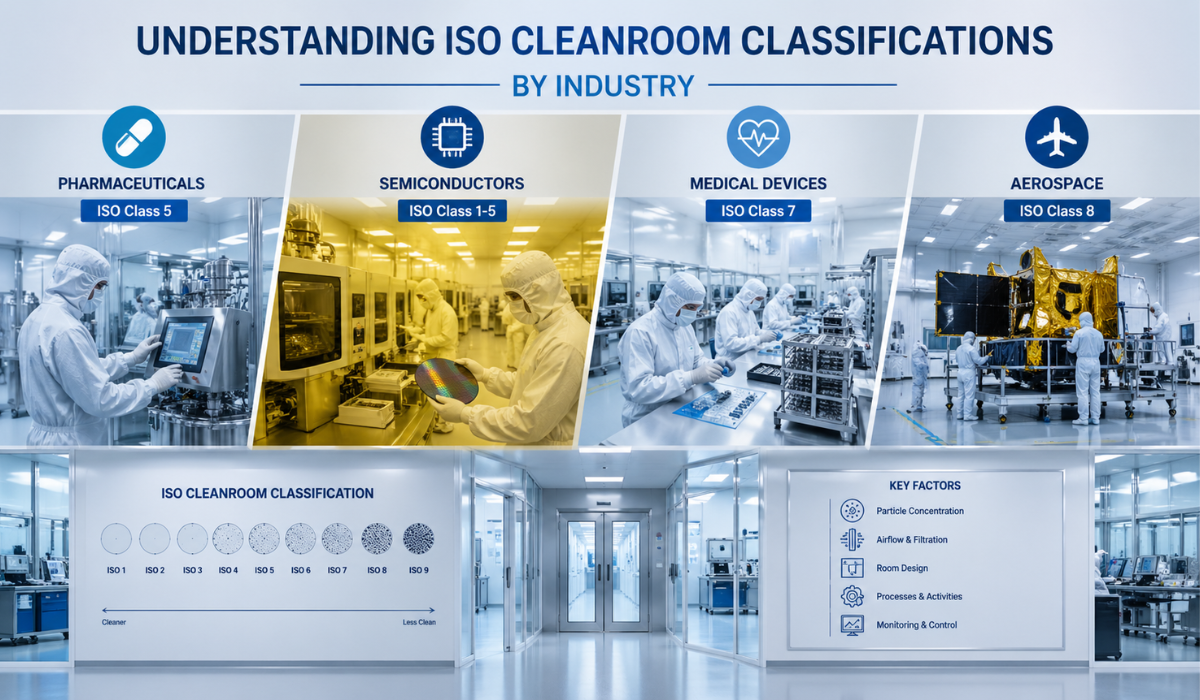
ISO 14644 measures the number and size of airborne particles allowed within a cleanroom. The lower the ISO class number, the cleaner the environment.
For example:
- ISO Class 1 is one of the cleanest possible environments
- ISO Class 5 is cleaner than ISO Class 7
- ISO Class 8 allows more airborne particles than ISO Class 6
Each ISO class has a maximum allowable particle concentration based on particles measured in micrometers.
The classification system is important because it provides a consistent framework that businesses can use across industries and facilities.
Why ISO Classification Matters in Cleanroom Design
The required ISO class has a major impact on cleanroom design and construction.
As the cleanliness requirement becomes stricter, the cleanroom generally requires:
- More HEPA or ULPA filtration
- Higher air change rates
- Greater pressure control
- More advanced HVAC systems
- More stringent gowning procedures
- Better contamination control processes
- Higher construction and operating costs
For example, an ISO Class 8 cleanroom used for basic packaging operations may require fewer air changes and less filtration than an ISO Class 5 pharmaceutical cleanroom used for sterile manufacturing.
Choosing the correct ISO classification during the design phase is critical because overbuilding can increase project costs, while underbuilding can create compliance issues and operational risks.
ISO Class 1 Cleanrooms
ISO Class 1 cleanrooms are among the cleanest controlled environments possible.
These rooms allow extremely low levels of airborne particles and are generally used for highly sensitive manufacturing and research applications.
ISO Class 1 environments are commonly found in:
- Advanced semiconductor manufacturing
- Nanotechnology research
- Aerospace applications
- Specialized optics production
These cleanrooms require extremely high air change rates, advanced filtration systems, and strict contamination control procedures.
Because of the complexity involved, ISO Class 1 cleanrooms are expensive to build and operate.
ISO Class 3 Cleanrooms
ISO Class 3 cleanrooms still require very low particle concentrations but are slightly less restrictive than ISO Class 1 environments.
Industries that commonly use ISO Class 3 cleanrooms include:
- Semiconductor manufacturing
- Microelectronics production
- Precision optics manufacturing
- Aerospace component assembly
These cleanrooms often require laminar airflow systems, ULPA filtration, and strict gowning protocols to minimize contamination.
Even small amounts of dust or airborne particles can damage sensitive products in these industries, which is why very low particle limits are required.
ISO Class 5 Cleanrooms
ISO Class 5 cleanrooms are some of the most commonly used controlled environments in pharmaceutical, biotechnology, and medical device industries.
An ISO Class 5 cleanroom allows a limited number of airborne particles and is often used in areas where sterile products are handled.
Industries and applications that often require ISO Class 5 cleanrooms include:
- Sterile pharmaceutical manufacturing
- Aseptic filling operations
- Biotechnology laboratories
- Medical device assembly
- Compounding pharmacies
- Hospital operating rooms
ISO Class 5 environments often use HEPA filtration, unidirectional airflow, and positive room pressure to reduce contamination.
In pharmaceutical settings, ISO Class 5 cleanrooms are frequently used inside larger cleanroom suites with surrounding rooms classified at ISO Class 7 or ISO Class 8.
ISO Class 6 Cleanrooms
ISO Class 6 cleanrooms are commonly used in industries that require moderate contamination control but do not need the stricter limits of ISO Class 5.
Common applications include:
- Electronics manufacturing
- Medical device production
- Pharmaceutical packaging
- Laboratory testing
- Optical assembly
ISO Class 6 cleanrooms usually require high air change rates and HEPA filtration, but they may not need the same level of airflow control as more stringent environments.
These cleanrooms are often used for processes where product sensitivity is important but not necessarily sterile.
ISO Class 7 Cleanrooms
ISO Class 7 cleanrooms are among the most widely used classifications across multiple industries.
They are commonly used for:
- Pharmaceutical manufacturing support areas
- Medical device manufacturing
- Electronics assembly
- Aerospace component production
- Food processing
- Laboratory spaces
ISO Class 7 cleanrooms generally require HEPA filtration, controlled airflow, and a moderate number of air changes per hour.
These environments are often suitable for operations that need contamination control but do not require sterile conditions.
In pharmaceutical facilities, ISO Class 7 cleanrooms are often used as buffer rooms or gowning areas that support cleaner ISO Class 5 spaces.
ISO Class 8 Cleanrooms
ISO Class 8 cleanrooms allow more airborne particles than ISO Class 7 and are commonly used for less sensitive processes.
Industries that frequently use ISO Class 8 cleanrooms include:
- Basic manufacturing operations
- Warehousing for clean products
- Packaging areas
- Plastic injection molding
- General electronics assembly
- Automotive component manufacturing
ISO Class 8 cleanrooms still require contamination control measures, but they generally have lower air change rates and less demanding filtration requirements than higher-class cleanrooms.
These cleanrooms are often more cost-effective to build and operate, making them a practical choice for businesses that do not require strict sterile environments.
Pharmaceutical Cleanroom Standards
Pharmaceutical cleanrooms are some of the most heavily regulated controlled environments because contamination can affect product safety and patient health.
Pharmaceutical manufacturing facilities often use a combination of ISO Class 5, ISO Class 7, and ISO Class 8 cleanrooms depending on the process being performed.
For example:
- ISO Class 5 may be used for aseptic filling or sterile compounding
- ISO Class 7 may be used for buffer rooms and clean corridors
- ISO Class 8 may be used for gowning areas and support spaces
In addition to ISO 14644 standards, pharmaceutical cleanrooms may also need to comply with:
- FDA regulations
- USP standards
- GMP guidelines
- EU cleanroom regulations
Because of these requirements, pharmaceutical cleanroom design often involves strict airflow control, pressure relationships, material finishes, and validation procedures.
Medical Device Cleanroom Standards
Medical device manufacturers use cleanrooms to protect products from contamination during assembly, packaging, and testing.
The required ISO class depends on the type of medical device being produced.
For example:
- Surgical implants may require ISO Class 5 or ISO Class 7 environments
- Diagnostic equipment may be assembled in ISO Class 7 or ISO Class 8 cleanrooms
- Packaging operations may require ISO Class 8 spaces
Medical device cleanrooms often require careful environmental monitoring, documented cleaning procedures, and routine testing to maintain compliance.
Semiconductor and Electronics Cleanroom Standards
Semiconductor and electronics manufacturing often require very strict cleanroom classifications because even microscopic particles can damage products.
Common ISO classifications in these industries include ISO Class 3, ISO Class 4, ISO Class 5, and ISO Class 6.
These environments often require:
- ULPA filtration
- Laminar airflow systems
- Static control measures
- Strict gowning requirements
- Advanced contamination monitoring
As product components become smaller and more sensitive, cleanroom requirements in these industries continue to become more demanding.
Aerospace Cleanroom Standards
Aerospace cleanrooms are used for manufacturing and assembling components that must remain free of dust, fibers, oils, and other contaminants.
Aerospace facilities may use ISO Class 5 through ISO Class 8 cleanrooms depending on the sensitivity of the equipment being handled.
Common aerospace cleanroom applications include:
- Satellite component assembly
- Optics manufacturing
- Sensor production
- Aircraft electronics assembly
- Space exploration equipment
These cleanrooms often require strict environmental control because contamination can affect performance, safety, and reliability.
Food and Beverage Cleanroom Standards
Food and beverage facilities may use cleanrooms to reduce contamination risks in sensitive production areas.
These cleanrooms are often classified as ISO Class 7 or ISO Class 8 environments.
Applications may include:
- Packaging operations
- Nutritional supplement production
- Dairy processing
- Beverage bottling
- Ready-to-eat food manufacturing
Food-related cleanrooms may also need to meet FDA requirements and food safety regulations in addition to ISO standards.
Choosing the Right ISO Classification
Selecting the correct ISO cleanroom classification depends on industry requirements, product sensitivity, contamination risks, regulatory standards, manufacturing processes, and budget.
Choosing an ISO class that is too high can increase construction and operating costs, while choosing one that is too low can create compliance issues and contamination risks.
Ultrapure Technology works with businesses to develop cleanroom solutions that align with operational needs, compliance goals, and future growth plans.
Conclusion
ISO cleanroom classifications provide a standard way to define cleanliness levels across industries and applications.
The required ISO class affects cleanroom design, HVAC systems, filtration, construction methods, operating procedures, and maintenance.
Different industries require different ISO classes based on the sensitivity of their products and processes.
Ultrapure Technology can help businesses design and build cleanrooms that meet the correct ISO classification, improve compliance, and support long-term operational success.
Frequently Asked Questions
What is the cleanest ISO cleanroom classification?
ISO Class 1 is one of the cleanest environments and allows the fewest airborne particles.
Which ISO class is most common in pharmaceutical cleanrooms?
ISO Class 5, ISO Class 7, and ISO Class 8 are commonly used in pharmaceutical manufacturing and support spaces.
Do stricter ISO classifications cost more?
Higher ISO classifications usually require more filtration, airflow control, and monitoring, which can increase costs.
Can one facility have multiple ISO cleanroom classes?
Many facilities use multiple ISO classifications in different areas based on the cleanliness needed for each process.