

EV battery cleanrooms are essential to modern electric vehicle manufacturing, providing tightly controlled environments required to produce high-performance lithium-ion batteries safely and consistently.
As EV production scales globally, manufacturers must control particulates, humidity, and airborne contaminants that can compromise battery quality, efficiency, and safety.
EV battery cleanrooms are engineered specifically to address the sensitivities of lithium-based chemistry.
Even microscopic particles or excess moisture can reduce battery lifespan, lower yield rates, or create serious safety risks.
This makes clean and dry rooms for EV batteries a foundational requirement for reliable, large-scale production.
This guide explains how EV battery cleanrooms are designed, the standards they follow, and the contamination control strategies that protect battery integrity throughout the manufacturing process.
What Are EV Battery Cleanrooms?
EV battery cleanrooms are controlled environments designed to regulate particulate levels, airflow, humidity, and electrostatic discharge during lithium-ion battery production.
These environments support sensitive manufacturing steps where contamination directly affects performance and safety.
EV battery production cleanrooms often integrate battery dry rooms that maintain extremely low moisture levels.
This combination of particulate control and humidity management ensures lithium materials remain stable during electrode preparation, cell assembly, and electrolyte filling.
Cleanroom classification for EV batteries varies by production stage, but all systems share a single objective: minimizing contamination risks that could impact yield, reliability, or compliance.
Why Contamination Control Is Critical in Battery Manufacturing
Particulate Contamination Risks
Particulate contamination control is one of the most important functions of EV battery cleanrooms.
Dust, fibers, and metallic particles can damage separators, puncture electrodes, or trigger internal short circuits within battery cells.
Common contamination sources include:
- Personnel movement
- Equipment wear
- Packaging materials
Even particles invisible to the naked eye can reduce battery reliability, making cleanroom solutions for battery manufacturing essential for protecting production quality.
Moisture and Humidity Sensitivity
Humidity control for lithium batteries is equally critical.
Lithium compounds react aggressively with moisture, causing chemical instability and reduced energy density.
Excess humidity during production can lead to premature battery degradation or failure.
Dew point control for battery manufacturing often requires environments maintained well below −40°C.
These conditions are achieved through advanced cleanroom HVAC design and industrial dehumidification systems.
Cleanroom Standards for EV Battery Production
ISO 14644 Cleanroom Standards
Most EV battery cleanrooms are designed to meet ISO 14644 cleanroom standards, which define acceptable airborne particle concentrations.
Depending on the production phase, cleanroom classifications typically range from ISO Class 5 to ISO Class 8.
Processes such as cell assembly and electrolyte handling require stricter particulate control, while downstream assembly steps may operate under less restrictive classifications.
EV Battery Production Standards and Compliance
EV battery production standards are also shaped by automotive quality requirements and safety regulations.
Many manufacturers exceed minimum ISO classifications to reduce defect rates and improve long-term reliability.
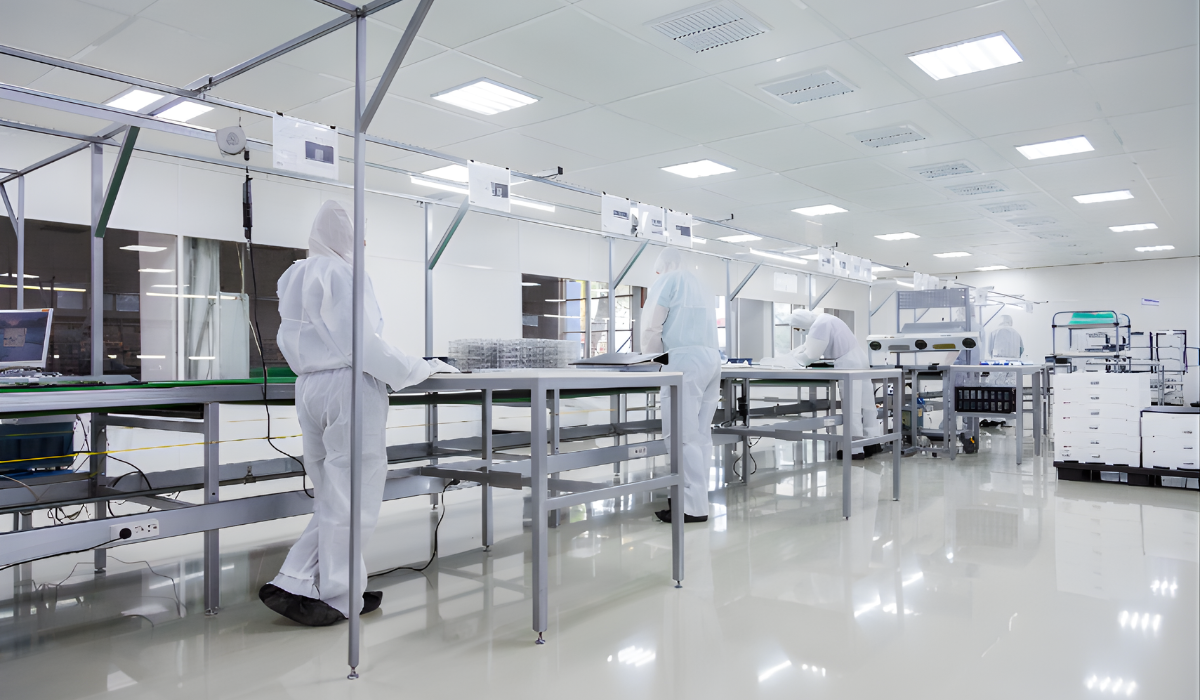
Cleanroom monitoring systems support compliance by providing real-time data on particulate levels, humidity, and pressure differentials.
Battery Dry Rooms and Cleanroom Environments
Battery dry rooms are specifically designed to maintain ultra-low humidity levels necessary for lithium-ion battery cleanroom operations.
While traditional cleanrooms focus primarily on particle control, dry rooms prioritize moisture elimination.
Clean and dry rooms for EV batteries are often integrated systems that provide:
- High-efficiency air filtration
- Aggressive dehumidification
- Controlled pressure zoning
Processes That Require Battery Dry Rooms
Battery dry rooms are essential for multiple critical stages of lithium-ion battery manufacturing where even trace moisture can compromise chemical stability and product integrity.
These controlled environments maintain ultra-low humidity levels to protect sensitive materials throughout production.
Electrode Coating and Handling
This stage requires dry conditions to prevent moisture absorption into active materials and binders.
Excess humidity can weaken coating adhesion, alter material composition, and negatively impact battery capacity and cycle life.
Cell Stacking and Winding
Cell stacking and winding involve precise layering of electrodes and separators.
Moisture exposure during assembly increases the risk of internal chemical reactions, separator degradation, and long-term performance loss, making consistent dew point control critical.
Electrolyte Filling
Electrolyte filling is among the most moisture-sensitive processes in battery manufacturing.
Humidity exposure at this stage can trigger unwanted chemical reactions, increase internal resistance, and elevate safety risks within the finished cell.
Dew Point Control for Battery Manufacturing
Without proper dew point control for battery manufacturing, these processes become vulnerable to chemical instability, reduced yield rates, and premature battery failure.
Purpose-built battery dry rooms within EV battery cleanroom environments ensure consistent conditions that protect quality, safety, and production efficiency.
Key Design Elements of EV Battery Cleanrooms
The performance and reliability of EV battery cleanrooms depend on precise engineering across multiple design elements.
Each component is carefully planned to control contamination, maintain environmental stability, and support high-volume battery manufacturing.
From air handling and humidity control to material selection and personnel movement, every detail plays a role in protecting sensitive lithium-ion processes and ensuring consistent production quality.
Cleanroom HVAC Design and Airflow Control
Cleanroom HVAC design determines airflow patterns, filtration efficiency, and pressure balance.
EV battery cleanrooms typically use HEPA or ULPA filtration systems to remove airborne contaminants before they reach critical production zones.
Airflow strategies are carefully engineered to prevent cross-contamination while maintaining consistent environmental conditions across the facility.
Humidity and Dew Point Control Systems
Humidity control for lithium batteries relies on industrial dehumidification systems designed for continuous operation.
Redundant systems are often incorporated to protect production uptime and environmental stability.
Continuous monitoring enables rapid response to environmental deviations, helping safeguard battery quality.
Materials, Layout, and Personnel Flow
EV battery cleanroom construction uses low-outgassing materials with smooth, cleanable surfaces.
Layouts are optimized to reduce personnel movement and streamline material flow, minimizing contamination risk throughout production.
Contamination Control Technologies Used in EV Battery Cleanrooms
Effective contamination control in EV battery cleanrooms depends on a combination of engineered systems and process-specific technologies.
These solutions are designed to minimize particulate introduction, limit environmental exposure, and protect moisture-sensitive lithium materials during critical production stages.
By controlling how people, materials, and air move through the cleanroom, these technologies help maintain stable conditions and consistent manufacturing quality.
Air Showers for Battery Cleanrooms
Air showers for battery cleanrooms remove surface particles from personnel and carts before entry.
Positioned at transition points, air showers significantly reduce the transfer of contaminants into controlled environments.
Gloveboxes for Lithium Battery Production
Gloveboxes for lithium battery production provide enclosed, controlled spaces for sensitive handling steps.
These systems often use inert atmospheres to protect lithium materials from moisture and oxygen exposure.
Cleanroom Monitoring Systems
Cleanroom monitoring systems continuously measure particle counts, humidity levels, and pressure differentials.
Automated alerts allow operators to address deviations before product quality is affected.
Modular vs Traditional EV Battery Cleanroom Construction
Modular cleanroom systems are widely adopted in EV battery manufacturing due to faster installation timelines, scalability, and reduced facility disruption.
Prefabricated components maintain consistent quality while allowing future expansion.
Traditional construction approaches may suit large permanent facilities, but modular cleanroom systems provide flexibility as production volumes and battery technologies evolve.
Designing EV Battery Cleanrooms for Future Scalability
EV battery manufacturing continues to evolve rapidly, making scalability a critical design consideration. EV battery cleanroom design should accommodate:
- Production growth
- Automation and robotics integration
- Emerging battery chemistries
Flexible cleanroom solutions for battery manufacturing help facilities remain competitive while reducing long-term capital risk.
Conclusion
EV battery cleanrooms form the foundation of safe, efficient, and scalable lithium-ion battery production.
Through effective particulate contamination control, humidity management, ISO compliance, and continuous monitoring, these environments protect battery integrity at every stage.
As EV demand continues to grow, investing in properly designed EV battery manufacturing cleanrooms supports consistent quality, improved yields, and long-term operational success.
EV Battery Cleanroom Solutions by Ultrapure Technology
At UltraPure Technology, we design and deliver advanced EV battery cleanrooms engineered for lithium-ion battery manufacturing.
Our expertise spans EV battery cleanroom design, modular cleanroom systems, battery dry rooms, and contamination control solutions built for compliance and scalability.
Contact our experts today to discuss a turnkey EV battery cleanroom solution designed for performance, safety, and future growth.
Frequently Asked Questions
What are EV battery cleanrooms used for?
EV battery cleanrooms provide controlled environments for lithium-ion battery manufacturing by regulating airborne particles, humidity, and airflow. These controls protect sensitive battery components from contamination that can reduce performance, safety, and lifespan. Cleanrooms help manufacturers maintain consistent quality and high production yields.
What ISO standards apply to EV battery cleanrooms?
EV battery cleanrooms typically follow ISO 14644 cleanroom standards, which define allowable particle concentrations. The required ISO classification depends on the manufacturing stage and contamination risk. Critical processes such as cell assembly often require stricter control levels.
Why is humidity control critical in lithium-ion battery manufacturing?
Lithium-based materials are highly sensitive to moisture exposure. Excess humidity can trigger chemical reactions that degrade battery performance and stability. Proper humidity and dew point control help prevent defects and extend battery life.
What is a battery dry room?
A battery dry room is a controlled environment designed to maintain extremely low humidity levels. These rooms protect moisture-sensitive lithium materials during electrode handling and cell assembly. Dry rooms are essential for safe and reliable battery production.
How do air showers help EV battery manufacturing?
Air showers remove dust and particles from personnel and equipment before entering cleanroom areas. They reduce the risk of contaminants being introduced into controlled environments. This added protection supports higher production quality and consistency.
Are modular cleanroom systems suitable for EV battery production?
Modular cleanroom systems are well-suited for EV battery manufacturing environments. They offer faster installation, scalability, and consistent quality control. Modular designs also allow facilities to expand as production needs grow.
What role do gloveboxes play in EV battery cleanrooms?
Gloveboxes provide enclosed environments for handling sensitive lithium materials. They often use inert atmospheres to protect materials from moisture and oxygen. This improves safety and process reliability during critical production steps.
How is contamination monitored in EV battery cleanrooms?
Cleanroom monitoring systems continuously measure particle counts, humidity, and pressure levels. Real-time data allows teams to detect deviations quickly. This helps maintain compliance and prevent quality issues.
How do EV battery cleanrooms support long-term scalability?
Designers build EV battery cleanrooms to support automation and future expansion. Flexible layouts and modular systems allow manufacturers to adapt to new technologies. This ensures long-term efficiency without compromising contamination control.