
Microelectronics manufacturing can involve components, patterns, and surface features that are highly sensitive to particles, static electricity, temperature changes, humidity, vibration, and chemical contamination.
A cleanroom used for pharmaceutical manufacturing may focus heavily on microbial control and protection of exposed products.
Microelectronics cleanroom construction usually prioritizes particle deposition, electrostatic discharge, environmental stability, process chemicals, and the effect of contamination on sensitive components.
Requirements vary among semiconductor wafer fabrication, printed circuit board assembly, sensor production, optics, packaging, and testing. For that reason, a microelectronics cleanroom should be designed around the process instead of relying on a general industry template.
Why Cleanrooms Are Crucial in the Microelectronics Industry
Particles that appear insignificant in an ordinary manufacturing facility can interfere with microelectronics production.
Cleanrooms may support processes such as:
- Semiconductor wafer fabrication
- Photolithography
- Thin-film deposition
- Etching and cleaning
- Printed circuit board assembly
- Sensor and optical-component manufacturing
- Microchip packaging
- Precision inspection and testing
Particle control is only one requirement. Some processes are also sensitive to static electricity, airborne molecular contamination, vibration, temperature variation, or moisture.
The required controls must reflect the product, process equipment, materials, chemicals, and acceptable defect levels.
How Does ISO 14644 Apply to Microelectronics Cleanrooms?
ISO 14644-1 classifies cleanrooms according to the concentration of airborne particles measured at specified particle sizes. It does not assign one mandatory ISO class to every microelectronics application.
ISO 14644-1 defines air-cleanliness classes based on airborne particle concentration.
A critical wafer-processing area may require cleaner conditions than a packaging, inspection, or support area. A single facility may therefore contain several zones with different cleanliness requirements.
The target classification influences the filtration strategy, airflow volume, filter coverage, room layout, envelope sealing, and operating procedures.
However, ISO classification alone does not address every contamination risk found in microelectronics manufacturing.
Other requirements may include:
- Electrostatic-discharge control
- Airborne molecular contamination control
- Temperature and humidity stability
- Vibration limits
- Process exhaust
- Chemical compatibility
- Ultrapure-water or specialty-gas systems
- Equipment-specific environmental conditions
The completed cleanroom must undergo particle-count testing before its ISO classification can be confirmed.
What Makes Microelectronics Cleanroom Construction Different?
Microelectronics cleanroom construction involves more than achieving a target ISO classification.
Depending on the manufacturing process, the facility may need to control airborne particles, electrostatic discharge, temperature, humidity, vibration, airflow, molecular contamination, and lighting conditions.
Not every microelectronics cleanroom requires the same controls. The design should be based on the product, process equipment, contamination sensitivity, environmental tolerances, and applicable quality requirements.
1. Process-Specific Particle Control
Airborne particles can settle on wafers, optical surfaces, sensors, circuits, and other sensitive components.
Depending on their size, composition, and location, these particles may interfere with processing or contribute to product defects.
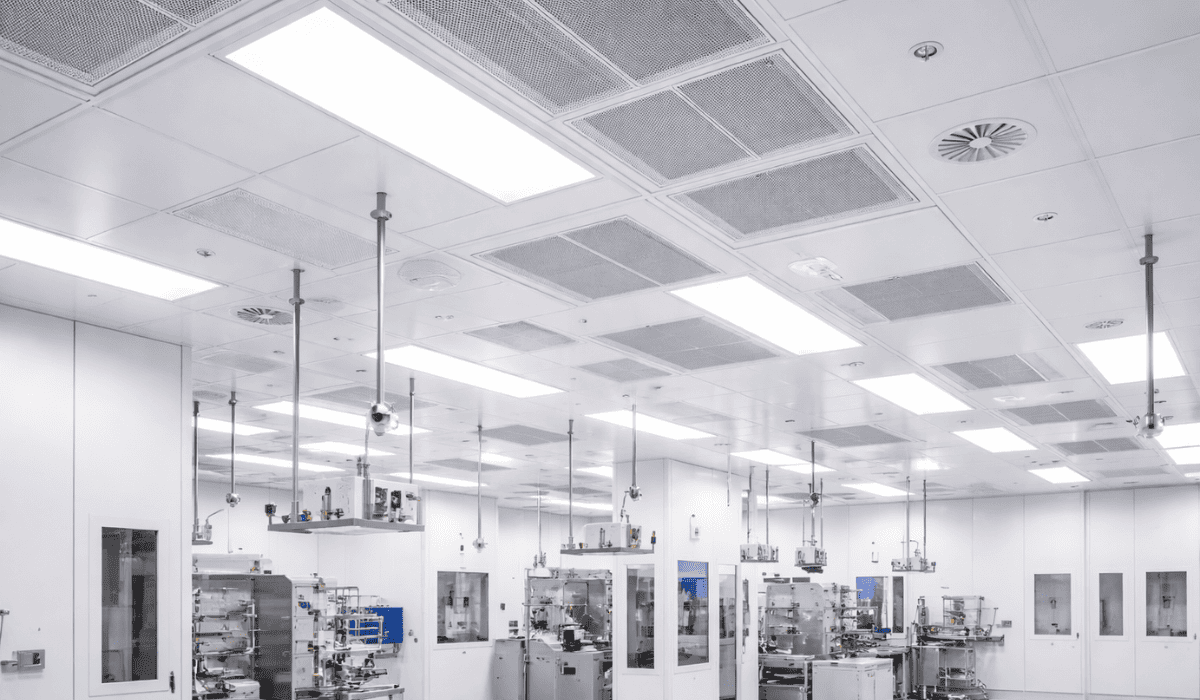
Microelectronics cleanrooms may use HEPA or ULPA filters to reduce airborne particles. The appropriate filter type, coverage, and airflow volume depend on the target classification, room layout, particle-generation rate, equipment, and manufacturing process.
Effective particle control also requires:
- Properly positioned supply and return air
- Controlled personnel and material movement
- Low-shedding construction materials
- Sealed joints and utility penetrations
- Cleanable walls, ceilings, floors, and equipment surfaces
- Appropriate gowning and cleaning procedures
Filter installation alone does not establish the room’s ISO classification. The completed cleanroom must undergo airborne particle-count testing under defined conditions.
2. Electrostatic-Discharge Control
Electrostatic discharge can damage sensitive electronic components or create defects that may not be immediately detected.
Microelectronics facilities may therefore require a coordinated ESD-control program rather than relying on one material or environmental setting.
Depending on the process, ESD controls may include:
- Static-control flooring
- Personnel-grounding systems
- ESD-compatible footwear and garments
- Grounded work surfaces
- Equipment bonding and grounding
- Ionization
- Suitable packaging and material handling
- Routine inspection and verification
Humidity can influence static generation, but it does not replace grounding, ionization, appropriate materials, and verified procedures.
ANSI/ESD S20.20 provides a framework for developing an ESD-control program based on the items and processes being protected.
3. Precise Temperature and Humidity Control
Some semiconductor and electronics processes require stable temperature and humidity to protect materials, support measurement accuracy, reduce condensation risk, and maintain equipment performance.
There is no single temperature or relative-humidity range for every microelectronics cleanroom. The appropriate limits depend on:
- Process sensitivity
- Equipment specifications
- Product materials
- Measurement tolerances
- Static-control requirements
- Chemical processes
- Personnel comfort
- Condensation risk
Tighter environmental tolerances can require more advanced HVAC controls, additional system capacity, detailed commissioning, and greater energy use. These requirements should be documented before the mechanical system is designed.
4. Vibration Control
Lithography, metrology, imaging, inspection, and other precision equipment may be affected by vibration from nearby machinery, building systems, personnel movement, or vehicle traffic.
The project team may need to evaluate:
- Existing floor vibration
- Structural stiffness
- Mechanical-equipment locations
- Pumps, fans, and compressors
- Foot and vehicle traffic
- Nearby production equipment
- Tool-specific vibration limits
Potential controls include isolated foundations, vibration-damping supports, suitable structural design, and separation of sensitive tools from major vibration sources.
Vibration requirements should be based on the equipment and process. Not every microelectronics cleanroom requires specialized vibration-isolation construction.
5. Airflow and Pressure-Zone Design
Airflow helps supply filtered air and remove airborne particles from critical areas. Its effectiveness depends on filter placement, supply and return locations, room geometry, equipment layout, process exhaust, and personnel activity.
Some microelectronics processes use unidirectional airflow, while others may use non-unidirectional or mixed-flow arrangements. The appropriate design depends on the required ISO classification and the location of sensitive work.
Pressure relationships may also help reduce contamination transfer between rooms. Cleaner areas are often maintained at a higher pressure than adjacent less-clean spaces when product protection is the main objective.
However, positive pressure should not be applied automatically. Processes involving hazardous chemicals, fumes, or gases may require containment or dedicated exhaust that affects the pressure strategy.
6. Process-Appropriate Lighting
Lighting requirements vary among manufacturing, assembly, inspection, and photolithography areas. Some operations require consistent illumination and accurate color rendering, while light-sensitive processes may require control of specific wavelengths.
Cleanroom lighting should be:
- Compatible with the manufacturing process
- Appropriately sealed
- Easy to clean
- Coordinated with ceiling filters and sprinklers
- Accessible for maintenance
- Included in the room’s heat-load calculations
Lighting specifications should be based on the work performed rather than applying one brightness or color-rendering level throughout the facility.
7. Adaptable Construction for Changing Processes
Microelectronics equipment and manufacturing requirements may change as products, tools, and technologies evolve.
Modular cleanroom construction may support future reconfiguration because selected wall panels, doors, windows, and other components can often be removed or repositioned. Its suitability depends on the available building space, HVAC capacity, utilities, equipment, and structural requirements.
Future expansion may affect:
- Airflow distribution
- Filter coverage
- Room pressure relationships
- Temperature and humidity control
- Electrical and process utilities
- Equipment clearances
- ESD controls
- Environmental monitoring
- ISO classification
Modular components may reduce the physical work required for some changes, but expansion or relocation is not automatically disruption-free. Proposed modifications should be reviewed by qualified cleanroom professionals and followed by appropriate testing or requalification.
Comparing Microelectronics Cleanrooms to Other Industries
Let’s look at how microelectronics cleanroom construction compares with other major sectors such as pharmaceuticals and biotechnology.
| Feature | Microelectronics Cleanroom | Pharmaceutical Cleanroom | Biotech Cleanroom |
| Main Focus | Particle & static control | Sterility & microbial control | Biosafety containment |
| Typical ISO Class | ISO 4–6 | ISO 7–8 | ISO 6–8 |
| Airflow Type | Laminar or unidirectional | Turbulent or mixed flow | Pressure-zoned |
| Surface Materials | ESD-safe, non-shedding | Non-porous & cleanable | Corrosion-resistant |
| Humidity Range | 40–50% RH | 45–60% RH | 30–70% RH |
| Vibration Control | Critical | Moderate | Minimal |
| Personnel Flow | Highly restricted | Controlled with gowning | Controlled with biosafety suits |
As you can see, microelectronics cleanrooms take contamination control to another level — focusing on particles, static electricity, and environmental stability rather than biological containment.
The Cleanroom Construction Process for Microelectronics
While each project is unique, the cleanroom construction process generally follows these steps:
- Consultation and Requirement Analysis: Understanding product type, process sensitivity, and target ISO classification.
- Design and Engineering: Creating layouts, airflow maps, and ESD-safe floor plans tailored to your production workflow.
- Material Selection: Choosing low-particle, static-dissipative panels, flooring, and ceiling systems that match your requirements.
- Mechanical Integration: Installing advanced HVAC systems with HEPA/ULPA filters and vibration isolation features.
- Electrical and ESD Setup: Grounding all equipment, lighting, and flooring to prevent static discharge.
- Validation and Certification: Conducting ISO particle testing, airflow verification, temperature/humidity stability tests, and pressure mapping before final approval.
Each phase requires tight coordination between engineers, technicians, and quality teams — which is why it’s essential to work with a certified cleanroom contractor experienced in microelectronics environments.
Benefits of Partnering with Ultrapure Technology
At Ultrapure Technology, we combine over 30 years of experience with the latest cleanroom technologies to deliver precision-engineered microelectronics cleanrooms.
Here’s what sets our process apart:
- Full Design-Build Capability: One team handles design, engineering, construction, and validation — ensuring seamless communication and accountability.
- Turnkey Solutions: From modular cleanrooms to advanced airflow systems, we deliver complete, ready-to-operate environments.
- ISO & ESD Expertise: Our cleanrooms meet ISO 14644 standards and include complete electrostatic discharge protection.
- Customized Scalability: Modular options let clients expand or upgrade facilities without downtime.
- Nationwide Experience: Over 500 successful projects for semiconductors, electronics, aerospace, and research labs across the U.S.
Our cleanrooms are engineered for precision, performance, and compliance — ensuring your production runs smoothly and safely.
Final Thoughts
In industries like microelectronics, where every atom counts, the environment is everything.
The difference between success and failure can come down to a single dust particle or a small static charge.
That’s why microelectronics cleanroom construction is one of the most demanding specialties in the world of controlled environments.
It requires advanced engineering, meticulous material selection, and an experienced team that understands how to manage airflow, humidity, vibration, and electrostatic energy with absolute precision.
At Ultrapure Technology, we’ve mastered that process — designing and building cleanrooms that keep your production safe, compliant, and efficient.
If you’re planning a new semiconductor facility or upgrading your current manufacturing space, you can talk to us and create a custom cleanroom system that meets the highest standards of ISO 14644, GMP, and ESD protection.
Frequently Asked Questions (FAQs)
What is a microelectronics cleanroom?
A microelectronics cleanroom is a specially engineered environment where air quality, temperature, humidity, and static electricity are tightly controlled to protect delicate components like semiconductors, sensors, and circuit boards. Even a single dust particle can damage a chip, so these rooms use advanced HEPA and ULPA filters to keep the air virtually particle-free.
How is microelectronics cleanroom construction different from pharmaceutical cleanrooms?
While both types of cleanrooms control contamination, microelectronics cleanrooms focus on particle and static control, whereas pharmaceutical cleanrooms emphasize microbial and sterile control. Electronics facilities use ESD-safe materials, vibration-resistant floors, and precise humidity control, while pharmaceutical rooms prioritize sterilization and gowning procedures for product safety.
What ISO class is required for semiconductor or microchip manufacturing?
Semiconductor and microchip production typically requires ISO Class 5 or cleaner environments under the ISO 14644 standard. This means fewer than 3,520 particles per cubic meter of air — far cleaner than most pharmaceutical or biotech cleanrooms. Support areas such as packaging or testing may operate at ISO Class 6 or 7.
Why is electrostatic discharge (ESD) control so important in microelectronics cleanrooms?
A single static spark can instantly destroy microchips or precision circuits. That’s why ESD control is built into every aspect of microelectronics cleanroom design — from conductive flooring and grounded work surfaces to humidity control and specialized garments. These measures prevent static buildup and protect sensitive components during manufacturing.